The book I couldn't write today
What happens when an engineer applies failure investigation thinking to Google Ads and tries to eliminate the black boxes?
Published July 2022. Last updated July 2026.
Disclaimer: This article is about a tool I built. If this makes you uncomfortable please don't read any further.
If your day is like mine, you access loads of web pages for each client:-
You've also got your internal pages and tools. I've got:-
I've never counted, but with say 20 and 30 clients we access hundreds or even thousands of web pages every week.
For example, checking a campaign in a client's Google Ads account. Before you can start work you have to:-
It takes 2 or 3 minutes of "commuting" before you can start work. And you lose another 3 minutes every time you change account or do some other kind of work. I'm told the average Google Ads manager will spend 7 years waiting for pages to load during their career.*
I'm guessing you've got some workarounds: - keep 100 tabs open, use tab groups or bookmarks on your browser, a spreadsheet with links and so on.
But workarounds are clunky. Too many tabs and you can't find what you're looking for, or they crash your machine. Browser bookmarks don't transfer between Chrome and Safari. And keeping the spreadsheet updated is a pain.
That’s where BookMarkPlus comes in...
Here's how I use BookMarkPlus to save hundreds of hours "commuting" to web pages in my PPC business.
When I onboard a new client I set up a group in BookMarkPlus to hold all the web pages for the client.
I start by creating BookMarkPlus links to my internal tools and folders. When I get access to their Google Ads account I'll copy the URL and set up a link in BookMarkPlus.
I'll do the same with every other page I need to get to for this client.
It takes 20 seconds to add a BookMarkPlus link. After that I never click-wait-click-wait-click-wait. I never hunt through my inbox and I never have to ask the client to resend a link.
Here's an screenshot of an example BookMarkPlus group.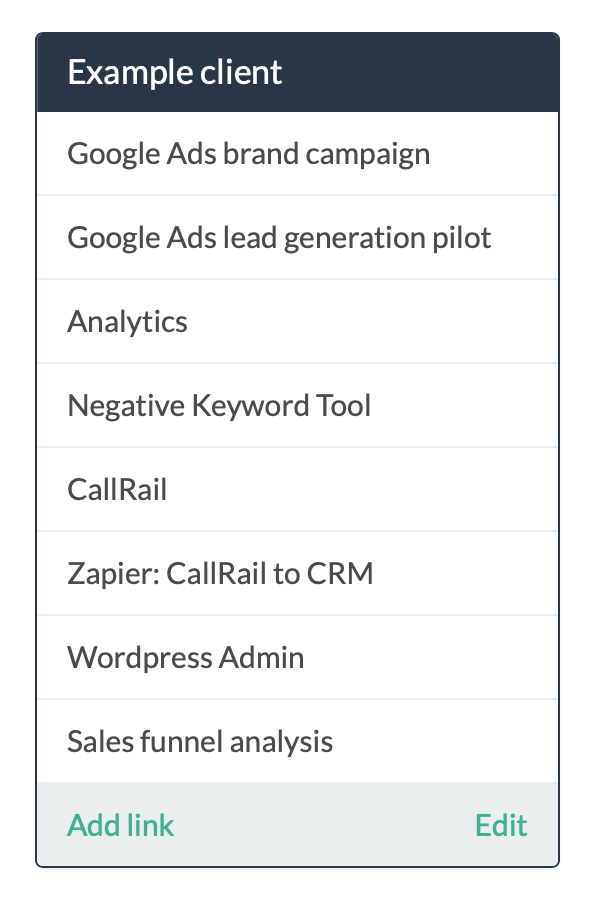
BookMarkPlus costs less than a cup of coffee a month but it frees up hundreds of dollars of billable hours every year.
Go here to try it out. If it works for you, email me and I'll credit your account for the first year.
*This statistic is a lie. I made it up but it feels like it could be true.

What happens when an engineer applies failure investigation thinking to Google Ads and tries to eliminate the black boxes?
Every tool or system that interacts with that lead creates a copy of some or all of the lead's personal data. But you're accountable for it
Discussions about the future of Google Ads usually start with what’s announced: new features, calling everything Max-this or AI-that. But often this is PR hype. I prefer to look at where Google continues to invest engineering effort over many years. It gives a clue to what the system will depend on in the future.
When I started with Google Ads in 2007, it was cheap. You could get away with a sloppy setup. That's not true today. Ads are expensive. You can't expect to be profitable if you haven't done everything in your power to get the setup right.
After building a lead-handling system that turned $8k in ad spend into $200k, I thought I knew what small businesses needed. I was wrong. This is the story of a good idea, a bad assumption, and what I learned about the real challenges of getting people to change.
One thing still amazes me: people pay for my advice - then ignore it completely. Sometimes they'll dismiss my suggestions without a second thought. Here's how I fix it.
Thoughts and lessons on client selection, burnout, pricing, and modernising legacy accounts, from someone who's run a Google Ads for years.
Understand what happens after someone clicks your advert. Subjects include offline conversions, CRM integration, attribution, auditability and marketing instrumentation.
Articles about marketing, engineering, AI and problem solving that don't fit neatly into the other topics. These are some of the ideas and experiences that have shaped how I think.
How to choose the right Google Ads agency, set them up to succeed, judge their work fairly, and build a relationship that delivers better business results.
Learn how to use Google Ads to generate profitable leads. Subjects include campaign strategy, bidding, targeting, optimisation and the challenges of running lead generation campaigns.
Understand why some leads become customers while others don't. Subjects include diagnosing poor leads, qualification, filtering junk leads and improving the feedback you send to Google Ads.
Things I've learned about high-converting landing pages. Subjects include copywriting, page structure, forms, trust, conversion rate optimisation and user experience.
What happens after a lead has been generated determines if Google Ads is profitable. Subjects include first contact, follow-up, quoting, lead nurturing and turning more enquiries into customers.