Agency insights
Thoughts and lessons on client selection, burnout, pricing, and modernising legacy accounts, from someone who's run a Google Ads for years.
Published April 2026. Last updated July 2026.
Google Ads can be a reliable source of new clients for Canadian immigration lawyers and consultants. And, many RCICs run Google Ads.
The ads bring enquiries. But there is one question many firms can't answer.
Are those leads actually turning into paying clients?
Google Ads can show you clicks and form submissions. But it can't tell you if the person was eligible, if they booked a consultation, or if they hired your firm.
So most immigration practices end up judging their advertising on the number of enquiries.
And that can be very misleading.
If you run Google Ads for immigration services, you've probably that your ads bring enquiries, but many of them aren't viable cases.
Google thinks every lead is a good lead. But from a business point of view they're a waste of money.
And the opposite can also happen.
You get an enquiry today, but they only hire you months later when they're ready to move forward.
Google can't see that either.
From the advertising system’s point of view, both of these situations look the same. The system only sees "form submitted, or call received".
This is a structural problem. Google can see what happens before the lead:
But it can't see what happens inside your practice after the enquiry arrives. That part of the prospect-to-client journey is managed somewhere else. Maybe in a system like CaseEasy 360.
They actually want to know:
When you can answer those questions, you can be confident that the money you spend on Google Ads is worth it.
The only way to do that is to connect your advertising to what happens after the lead arrives. To track the full journey from click to client.
In simple terms, that means three things:
Once Google can see which leads turn into real clients, it can show your ads to people who are more likely to turn into real clients. You can optimise your ads to produce better leads instead of just more leads.
For one RCIC client I work with, the workflow looks roughly like this.
From there, the firm handles the normal qualification process and decides if the case is viable.
Behind the scenes, I use a system called Litiro to capture the lead together with its advertising data and pass the prospect into CaseEasy 360 through Zapier.
Here's what the flow looks like.
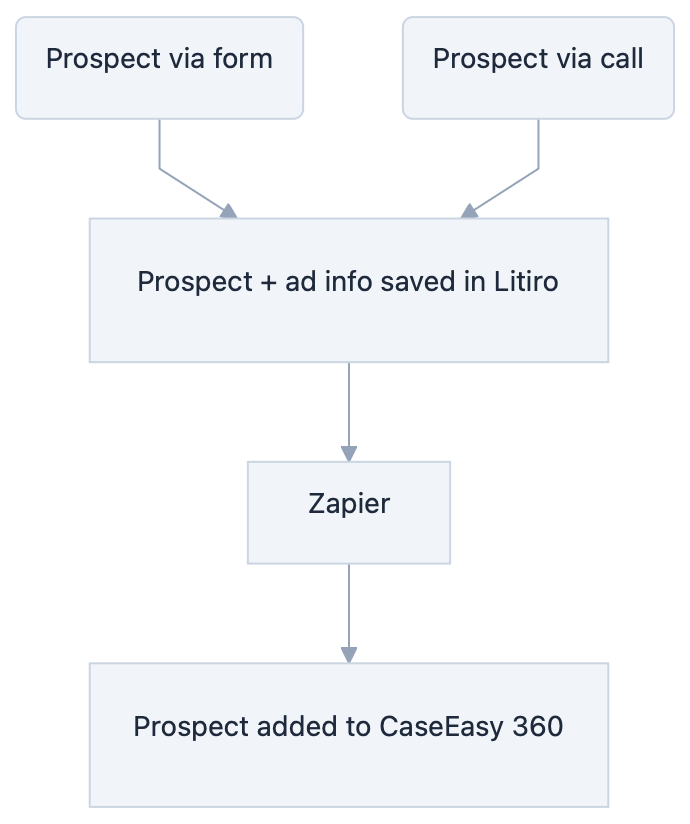
As the lead progresses from prospect to evaluation to client, the firm records that in Litiro. Litiro feeds these events back to Google Ads as offline conversions.
We haven't changed how the firm works day to day, we've just closed the loop between advertising and sales. This makes it possible to see which advertising campaigns produced real cases rather than just enquiries. And, it helps Google find better prospects.
Immigration advertising often produces a high number of enquiries that are not eligible.
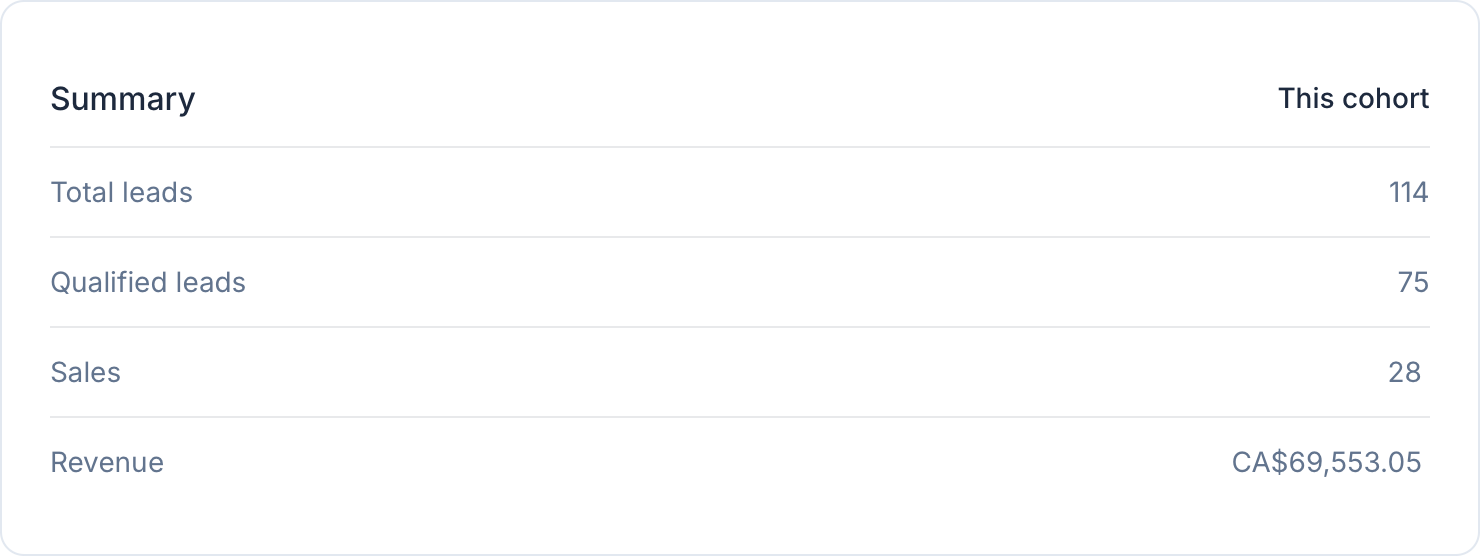
Without tracking what happens after the lead arrives, those enquiries look exactly the same as real clients. Once you connect the data, the picture becomes much clearer.
Here's an example of the report the system produces to help us make better descisions about where to spend the ad budget.

For permanent decisions, prospects care less about getting the best deal than avoiding a terrible mistake.
I’ve long believed Google Ads is only profitable when the processes around it work. One of the most important is how quotes turn into sales.
Many businesses can’t answer a basic question: Did this ad actually make us money? Why is something so important invisible inside the software that runs the business? The reason is simple. Advertising systems are designed to measure marketing activity. Business systems are designed to manage operations and finances. Neither system was designed to understand the full journey from ad click to revenue.
There is an invisible problem that could be draining your ad budget or causing you to miss sales. If you use a call tracking platform for call assets or landing page numbers, you might be at risk.
I spoke recently with my friend Liam Lezra, who knows more about marketing for auto repair shops than anyone I know. Our conversation turned to a problem he runs into often.
It decays when people change things without understanding how systems are connected. And this makes life very difficult for anyone managing Google Ads. You end up basing important decisions on distorted data.
Thoughts and lessons on client selection, burnout, pricing, and modernising legacy accounts, from someone who's run a Google Ads for years.
Understand what happens after someone clicks your advert. Subjects include offline conversions, CRM integration, attribution, auditability and marketing instrumentation.
Articles about marketing, engineering, AI and problem solving that don't fit neatly into the other topics. These are some of the ideas and experiences that have shaped how I think.
How to choose the right Google Ads agency, set them up to succeed, judge their work fairly, and build a relationship that delivers better business results.
Learn how to use Google Ads to generate profitable leads. Subjects include campaign strategy, bidding, targeting, optimisation and the challenges of running lead generation campaigns.
Understand why some leads become customers while others don't. Subjects include diagnosing poor leads, qualification, filtering junk leads and improving the feedback you send to Google Ads.
Things I've learned about high-converting landing pages. Subjects include copywriting, page structure, forms, trust, conversion rate optimisation and user experience.
What happens after a lead has been generated determines if Google Ads is profitable. Subjects include first contact, follow-up, quoting, lead nurturing and turning more enquiries into customers.