Your Google Ads are working. So why are you running out of cash?
How a successful Google Ads campaign can leave your business short of cash.
Published October 2024. Last updated July 2026.
A solid negative keyword strategy can boost your conversion rate and reduce your cost per lead. That’s because negative keywords block your ads from being shown to people outside your target market.
Here’s what's working for me at the moment.
Keyword research is usually about finding keywords to target. But finding keywords not to target is just as important. And, knowing what not to target before you start spending money leads to better quality leads sooner.
I use the Google Ads keyword planner to come up with a long list of keywords Google thinks are relevant. I'll then share my screen with the client and we'll select keywords and negative keywords.
This takes a while, but it's a good investment in understanding the nuances of their business. (Screenshot of my keyword tool below. The buttons make it quick to select a keyword or add it to the negative list.)
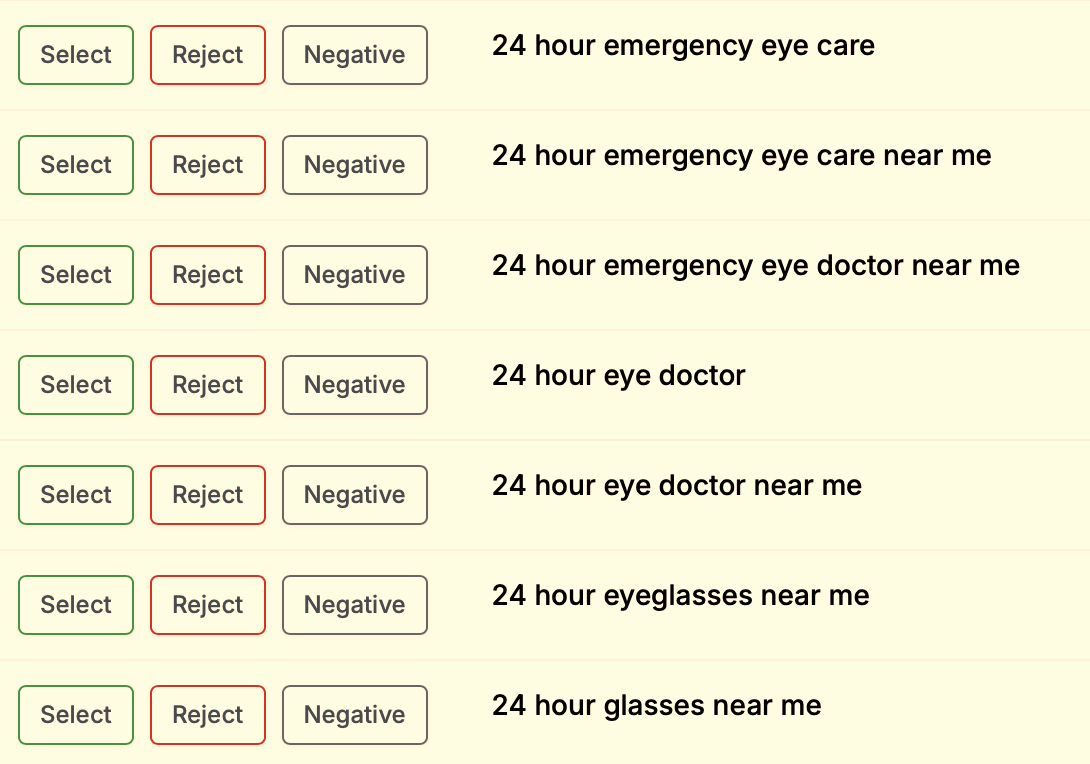
Over the years, I’ve built a hefty list of negative keywords that apply to most campaigns. It includes terms like job, jobs, salary, hire, free, cheap and more. It's a good starting point for reducing irrelevant traffic.
There are loads of pre-built negative keyword lists floating around the internet. It's worthwhile grabbing a few and refining them to fit your business.
The search terms report shows some of the searches - what people typed into Google - that triggered your ads.
In the first few months of a campaign, I check the search terms report often. Exactly how often depends on:-
As a rule of thumb I'll review the search terms report every week for new campaigns. As the bidding algorithm learns which searches turn into quality leads I'll review the report less frequently.
I prefer managing negative keywords using shared lists. Shared negative keyword lists can be linked to more than one campaign. This means you only have to add, and manage, negative keywords in one place.
Currently, you can have up to 5,000 negative keywords per list and 20 lists per account. Most of the time I only need 4.
Wrong intent. This list stops irrelevant searches. E.g. I have a client who sells alarm monitoring software. Google thinks alarm programming software is the same thing. It's not, so we have programming as a negative keyword in this list.
Competitors. I don't want my ads showing when someone searches for a competitor by name, unless I'm running a competitor campaign. You see, generally clicks on competitor searches are a waste of money. Someone searches for the competitor and Google shows an ad. The person clicks the first thing they see thinking it's the business they're after. These don't often turn into sales.
Brand. I generally exclude a client’s own business name from regular campaigns. Instead, I might set up a separate campaign targeting people searching for the firm by name. That way we can control the cost of these searches separately.
Poor performing searches. If a search query consistently leads to expensive or low-quality leads, I add it to this list. This is a leftover from the time before smart bidding, but it can help reduce wasted spend.
Broad, phrase and exact match negative keywords don't work like broad, phrase and exact match keywords. Here's a quick summary:-
For more details, check out Google’s official guide on negative keyword match types here.
I've seen accounts that look like this...
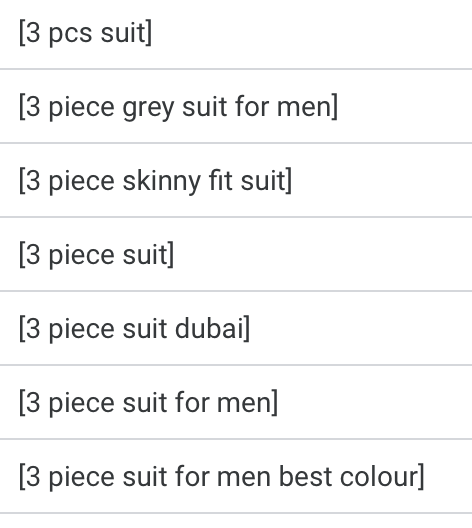
This business doesn't sell 3 piece suits. The person running the account put effort into adding negative keywords, but because they're exact match they'll only block these exact phrases. They won't block any other variations in the future.
If he adds the broad match negative 3 piece it'll block all future searches containing the words 3 piece. Much less work and a better result.
A singular negative keyword e.g. sign won't block searches that include the plural e.g. road signs.
And, negative keywords with symbols won't block the same word without symbols. e.g the negative keyword café won't block searches containing the word cafe. Crazy right?
Every time I add a word as a negative I add as many variations as I can e.g. if I wanted to block searches about signs I'd add sign, signs, signage, signboard, signboards, signpost and signposts.
Once you’ve added broad or phrase match negative keywords, many of your exact match negative keywords might be redundant. While you could remove them for a shorter, cleaner list, it’s not necessary.

How a successful Google Ads campaign can leave your business short of cash.
Two tricky targeting problems, a possible campaign strategy, and one important question: can we generate profitable leads?
Stop paying for searches you don’t want. Here are the five negative keyword lists I normally use when building Google Ads campaigns for service businesses.
A simple AI prompt to help block searches for places you don’t serve.
When Google matches the wrong search, your ad copy can stop the click. What happens when Google writes the ad to fit its mistake?
If nobody can help your leads, why keep paying for them? Here’s what I’ve seen after years of pausing and restarting clients’ Google Ads.
Thoughts and lessons on client selection, burnout, pricing, and modernising legacy accounts, from someone who's run a Google Ads for years.
Understand what happens after someone clicks your advert. Subjects include offline conversions, CRM integration, attribution, auditability and marketing instrumentation.
Articles about marketing, engineering, AI and problem solving that don't fit neatly into the other topics. These are some of the ideas and experiences that have shaped how I think.
How to choose the right Google Ads agency, set them up to succeed, judge their work fairly, and build a relationship that delivers better business results.
Learn how to use Google Ads to generate profitable leads. Subjects include campaign strategy, bidding, targeting, optimisation and the challenges of running lead generation campaigns.
Understand why some leads become customers while others don't. Subjects include diagnosing poor leads, qualification, filtering junk leads and improving the feedback you send to Google Ads.
Things I've learned about high-converting landing pages. Subjects include copywriting, page structure, forms, trust, conversion rate optimisation and user experience.
What happens after a lead has been generated determines if Google Ads is profitable. Subjects include first contact, follow-up, quoting, lead nurturing and turning more enquiries into customers.