Agency insights
Thoughts and lessons on client selection, burnout, pricing, and modernising legacy accounts, from someone who's run a Google Ads for years.
Published July 2026. Last updated July 2026.
A while ago I was auditing a Google Ads account. The client pushed back at one of my suggestions. That lead to two interesting realisations:
Both me and my client were basing important decisions on opinion, not evidence.
Auditing a Google Ads account isn't enough. We need to audit the whole lead generation system to find the most significant opportunities.
This article ties both of these back into a logical starting point for all future audits I do. It starts with a question.
What do you know about the last Google Ads lead you sold to?
Every lead leaves a trail of evidence as it moves through your business. If you could collect all the evidence, you'd have a complete history of the lead from first click to sale.
It's like doing a round-the-world trip. Every country you enter stamps your passport.
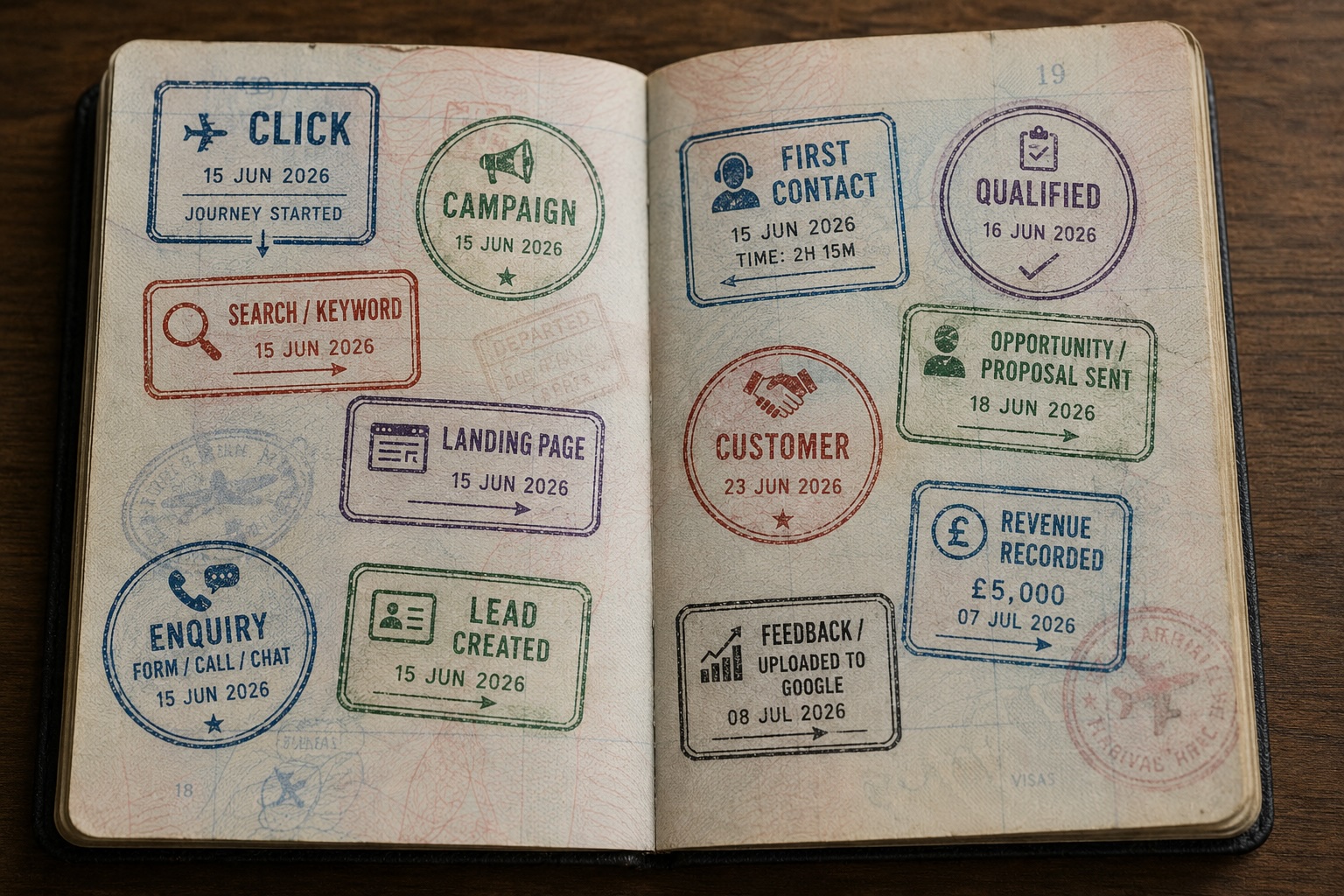
A complete lead passport would have stamps showing everything from click to sale.
Each stamp answers a question about what happened to that lead.
Put all the stamps together and you can reconstruct its entire journey through your business. Miss a few stamps and parts of the story disappear.
A complete passport records the ads:
It records how the lead was created:
It records the first contact with the lead:
It records if the lead was qualified or not:
It records if you did an estimate or quote:
And it records if there was a sale or not:
How many of those could you answer for the last lead you sold?
Looking at the last lead doesn't tell you much. But if you looked at all your leads you'd start to see answers to important questions like:
Unfortunately a lot of businesses don't have this insight. They either don't save the information, or it can't be retrieved in a useful format. And that means important decisions aren't supported by evidence.
But this doesn't have to be permanent. Every lead generates the information you need to make the right decisions. It just has to be saved and used.
The first step is to figure out where the gaps are. Which borders aren't stamping the passports.
That's where the Google Ads Evidence Scorecard comes in.
It'll show you where your business is missing the evidence to support better decisions.
It's free, takes about five minutes, and you can find it here: https://pete-bowen.com/google-ads-evidence-scorecard

If nobody can help your leads, why keep paying for them? Here’s what I’ve seen after years of pausing and restarting clients’ Google Ads.
It is almost always cheaper to get a happy customer to return than to win another one through advertising.
If every enquiry looks equally valuable, Google will chase quantity. Does it ever learn which leads actually become customers?
I trace every route from the ad to the CRM to find leads and tracking data that go missing.
The ad account says the leads are good. The sales team says they aren’t. Who has the evidence needed to decide?
Finding problems is easy. The difficult part is identifying the few evidence gaps that could materially affect leads, decisions and profitability.
Thoughts and lessons on client selection, burnout, pricing, and modernising legacy accounts, from someone who's run a Google Ads for years.
Understand what happens after someone clicks your advert. Subjects include offline conversions, CRM integration, attribution, auditability and marketing instrumentation.
Articles about marketing, engineering, AI and problem solving that don't fit neatly into the other topics. These are some of the ideas and experiences that have shaped how I think.
How to choose the right Google Ads agency, set them up to succeed, judge their work fairly, and build a relationship that delivers better business results.
Learn how to use Google Ads to generate profitable leads. Subjects include campaign strategy, bidding, targeting, optimisation and the challenges of running lead generation campaigns.
Understand why some leads become customers while others don't. Subjects include diagnosing poor leads, qualification, filtering junk leads and improving the feedback you send to Google Ads.
Things I've learned about high-converting landing pages. Subjects include copywriting, page structure, forms, trust, conversion rate optimisation and user experience.
What happens after a lead has been generated determines if Google Ads is profitable. Subjects include first contact, follow-up, quoting, lead nurturing and turning more enquiries into customers.