Agency insights
Thoughts and lessons on client selection, burnout, pricing, and modernising legacy accounts, from someone who's run a Google Ads for years.
Published February 2026. Last updated July 2026.
You can't run profitable Google Ads without working plumbing - the systems that carry data from the website, to the business and back to Google.
This data is crucial:
The problem is that the data is siloed. It's in Google Ads. It's in call tracking systems like CallRail or WhatConverts. It's in CRMs, spreadsheets and post-it notes.
In most cases one of two things happen:
The data stays in siloes. Everyone sees different numbers. The owner sees ad spend. The ad manager sees leads. Sales sees bookings. No one is basing their decisions on the complete picture.
Data flows between silos via a mishmash of native integrations, Zapier and duct tape. This is brittle and prone to silent failures. When something goes wrong nobody notices until campaign performance suffers. Then the ad manager gets it in the neck. They waste hours or days trying to unearth the root cause, fix it and repair the damage.
The plumbing is important enough to be designed, monitored and maintained. So I'm designing, monitoring and maintaining it.
I've done this a handful of times for larger clients where a bespoke solution made sense. I've also built several public-facing tools that solve parts of the plumbing problem, so the work isn't new to me.
What’s new is making the same interface useful for businesses generating 30 leads a month and 3,000.
This week I’ve been working on the layer that monitors the data flow and flags problems.
Profitable Google Ads needs four kinds of data:
If data stops flowing through any one pipe, performance suffers. We need to know that each pipe is functional.
Here’s the early version of the data health dashboard.
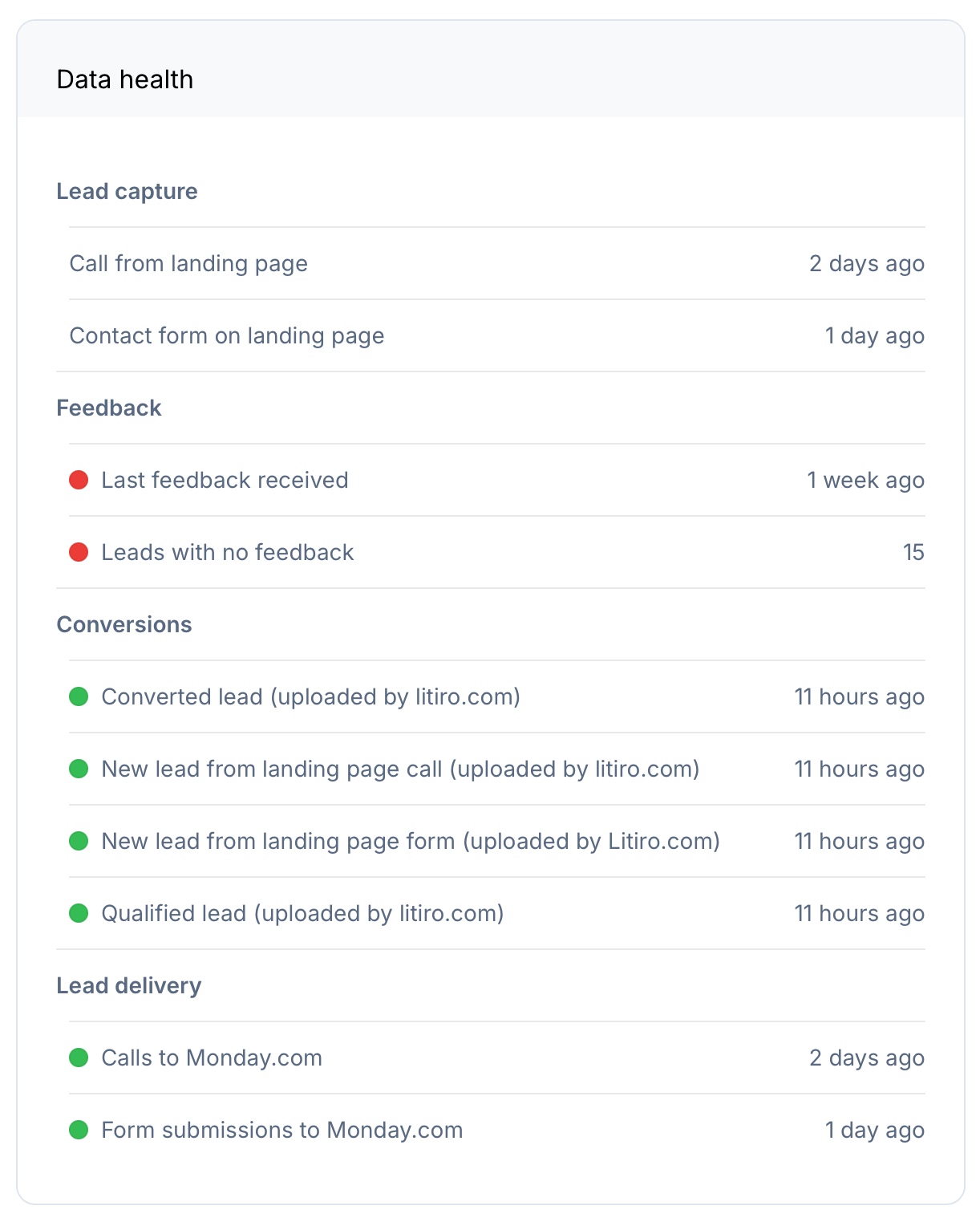
Conversion flow is predictable. Google fetches once per day. If it misses its window by more than six hours, the dashboard turns red. So you don't find out a week later that tracking broke.
Feedback flow is predictable too. If leads sit unmarked for too long, the dashboard turns red.
And the delivery flow is also predictable. Leads go out by email or webhook. If delivery fails, the dashboard turns red.
Lead capture is unpredictable.
A business that gets 50 calls a day needs to know if it only got five. But a business that gets 20 calls a month expects quiet days.
Figuring out the difference between a broken pipe and normal dip is tricky:
I modelled ideas using rolling averages, weighted rolling averages and user-defined thresholds. None of them felt reliable.
So for now, I’ve settled on something simpler. The dashboard shows when the last lead arrived. It’s not perfect. But combined with what I know about each of the accounts I manage it's enough to warn me if something's not working.
If you’re responsible for performance but you’re not completely sure the data can be trusted, that’s uncomfortable. I'd love to show you what I'm working on and get your thoughts. Message me and we'll make it happen.

If nobody can help your leads, why keep paying for them? Here’s what I’ve seen after years of pausing and restarting clients’ Google Ads.
It is almost always cheaper to get a happy customer to return than to win another one through advertising.
If every enquiry looks equally valuable, Google will chase quantity. Does it ever learn which leads actually become customers?
I trace every route from the ad to the CRM to find leads and tracking data that go missing.
The ad account says the leads are good. The sales team says they aren’t. Who has the evidence needed to decide?
Finding problems is easy. The difficult part is identifying the few evidence gaps that could materially affect leads, decisions and profitability.
Thoughts and lessons on client selection, burnout, pricing, and modernising legacy accounts, from someone who's run a Google Ads for years.
Understand what happens after someone clicks your advert. Subjects include offline conversions, CRM integration, attribution, auditability and marketing instrumentation.
Articles about marketing, engineering, AI and problem solving that don't fit neatly into the other topics. These are some of the ideas and experiences that have shaped how I think.
How to choose the right Google Ads agency, set them up to succeed, judge their work fairly, and build a relationship that delivers better business results.
Learn how to use Google Ads to generate profitable leads. Subjects include campaign strategy, bidding, targeting, optimisation and the challenges of running lead generation campaigns.
Understand why some leads become customers while others don't. Subjects include diagnosing poor leads, qualification, filtering junk leads and improving the feedback you send to Google Ads.
Things I've learned about high-converting landing pages. Subjects include copywriting, page structure, forms, trust, conversion rate optimisation and user experience.
What happens after a lead has been generated determines if Google Ads is profitable. Subjects include first contact, follow-up, quoting, lead nurturing and turning more enquiries into customers.