When there is a Google Ads lead quality problem most people start by checking the search terms report. If they can't find the answer there, they look at the keywords, ad copy, landing pages and conversion tracking.
These are all smart things to do.
But, sometimes the answer isn't there. The search terms look relevant, conversion tracking is firing and there have been no recent changes to the ad copy or landing pages.
If that's the case it can be worth looking at one place most people don't consider: the contact method.
Aside: I wrote about this topic previously in How Contact Method Influences Lead Quality. This article takes the idea a step further. Rather than discussing whether contact method matters, I want to look at how to measure it and use it to improve lead quality.
Sometimes how people contact you (call, form, message etc) correlates with how likely they are to buy.
Let me give you a couple of examples from businesses I've worked with.
An emergency locksmith found that his best leads were people who called from the click-to-call button on his ads. (The call asset). They were locked out. They Googled for help and clicked the first call button on the list. Most of the time the first available locksmith got the job.
But, calls from the number on his website hardly ever turned into jobs. These calls usually came from people who had already clicked the first button and were horrified at the cost. They then clicked the links lower on the page which don't have click-to-call buttons, looking for a better deal. They'd get to his site and call the listed number. He charged about the same as everyone else so he didn't get the job.
A specialist luggage courier found the exact opposite. Most calls from their ad assets were people looking for their suitcases. Sometimes they weren't even her customers.
People who called the number on their website were far more likely to want to book. They'd checked that the business served the area they were travelling to and were comfortable with the service.
The website acted as a filter.
And one more. A legal document translation service. They had a form and a WhatsApp button on their website.
They found that leads that contacted them via WhatsApp were more likely to be individuals in a hurry. A foreign birth certificate for a passport application, a foreign degree for a job interview and so on.
These weren't great leads. They were in a hurry, they were once-offs and they didn't pay much.
Leads from their contact form were usually better. Mostly businesses who needed ongoing translation services for things like export paperwork. The work could be scheduled in advance and they weren't as sensitive to the price.
Once you know which contact methods produce the best (or worst) leads it becomes another optimisation lever. You can change ad assets, landing pages and even bidding strategies to take advantage of this.
The locksmith ran call only campaigns (RIP) and used the Target impression share bid strategy to show his ads at the top of the page.
The luggage courier deleted the phone number from her ads so she wasn't paying Google for customer-service calls.
The translation service did nothing. Although they'd have preferred more B2B work, there wasn't enough of it yet. The urgent WhatsApp leads helped pay the bills.
The problem is that a lot of businesses can't prioritise the best contact method because they don't know which one it is.
The information exists at the lead source:
But, often once the lead starts the sales process, it's discarded. At that point it's just another lead.
And so most businesses can't answer questions like:
Here's how to change that.
If you're using Google Ads then people can contact you via:
You can identify where a call came from using a call tracking service like CallRail or WhatConverts. Or, you could use a separate phone number for each type of call. Phone numbers are cheap from services like Twilio.
You could use something like Convertista (I built this) to track messages from a WhatsApp button on your website.
Forms, messages, emails and live chat don't need a separate system to identify them as the contact method.
I use Litiro (I built this too) to create a parallel record for every lead. It stores the contact method along with the outcome data (was the lead qualified, did they buy etc).
This means the contact method doesn't get lost when the lead enters the sales process and allows me to compare outcomes by contact method later.
In practice, that's harder than it sounds. Some clients don't have a CRM. Some have one that doesn't preserve the contact method. Some have one that preserves the data but can't report on it. Some use several systems that don't talk to each other.
Keeping a parallel record with the data I need means I can help my clients get better value from their Google Ads without having to do a bunch of systems engineering first.
Once you've got enough data you can start to figure out there is a difference in outcome based on contact method. Here's how Litiro surfaces it.
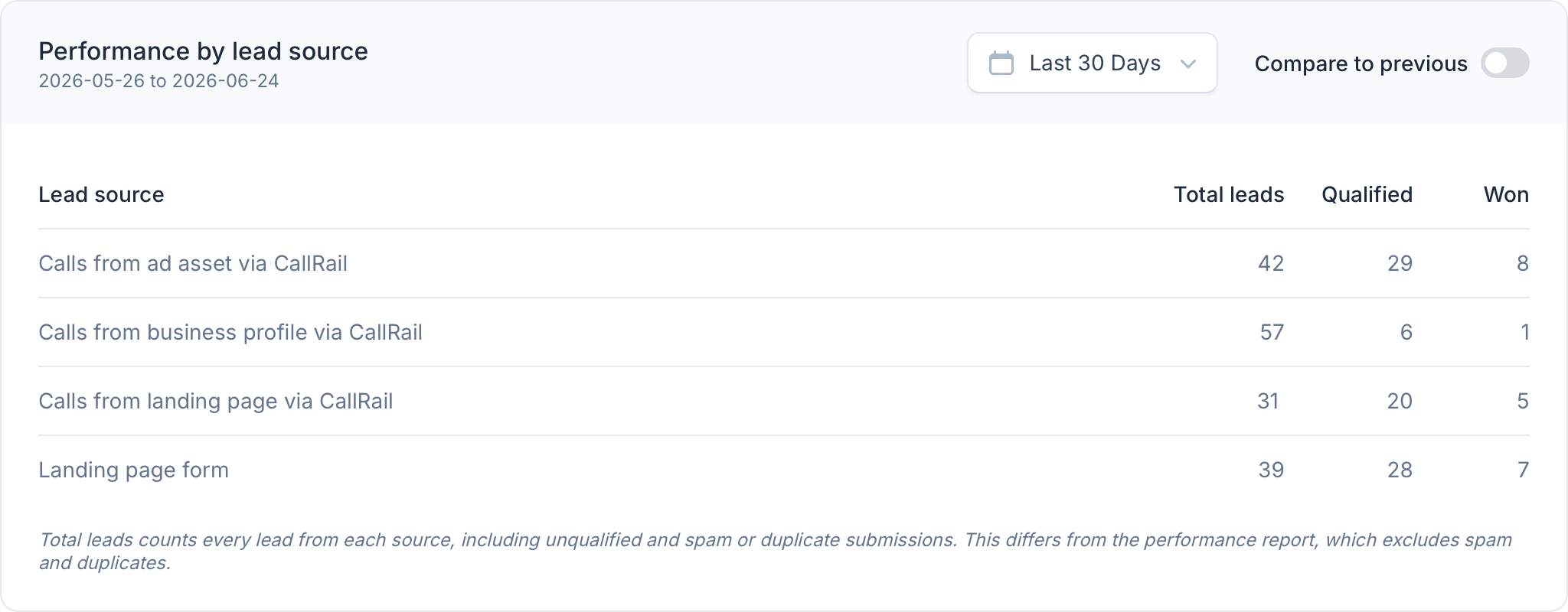
Although this report shows sales, I prefer to use qualified leads for the comparison. In my mind qualified leads are a better metric for looking at how well the marketing is doing than sales.
You see, sales are affected by factors outside marketing. For example availability. My locksmith could get call from a lady locked out of her car. In a rough area. Holding a baby. In the rain. And the dark. But if all his guys are out on jobs he won't win the sale.
It's still a good lead though.
That's why I prefer qualified leads. They tell me if the marketing is attracting the right kind of people, without being distorted by what happened afterwards.
Most people think lead quality starts with targeting. They're right, mostly. But sometimes how people contact you is a factor.
If you're struggling with lead quality and the usual explanations don't fit, it might be worth looking digging into this.
Offline conversion tracking with Contact Form 7 Contact Form 7 is one of the most popular form plugins for WordPress. But, if you're running Google Ads, there is a problem. Contact Form 7 can tell you that somebody submitted a form. It can't tell Google Ads if that person became a customer.
Why agencies struggle to improve Google Ads lead quality These days optimising Google Ads for raw leads - someone filling in a form or calling - eventually fills your inbox with the kind of leads nobody wants. Spam, wrong numbers and so on. Most agencies know this by now. They also know the solution: upload qualified leads as offline conversions. The real problem is getting clients to tell us which leads are qualified.
Testing Google Ads for an RV Campground The goal was to spend a small amount, gather data, and see what actually happens. We got bookings, but the value distribution surprised me and changed how I'm going to structure this account.
Why your Google Ads leads suddenly turn to junk I helped with two struggling Google Ads accounts. The problems had different symptoms, but the root cause was the same.
The data gap between advertising and sales Many businesses can’t answer a basic question: Did this ad actually make us money? Why is something so important invisible inside the software that runs the business? The reason is simple. Advertising systems are designed to measure marketing activity. Business systems are designed to manage operations and finances. Neither system was designed to understand the full journey from ad click to revenue.
Why many RCICs don’t know if their Google Ads are profitable Google Ads can be a reliable source of new clients for Canadian immigration lawyers and consultants. The ads bring enquiries. But there is one question many firms can't answer: Are those leads actually turning into paying clients?
Why negative keywords are becoming less effective in Google Ads Adding negative keywords from the search terms report has always been part of diligent Google Ads management. But while it's still important, it's becoming less and less effective. Here's what's working for me today.
The invisible Google Ads problem: zero-second calls There is an invisible problem that could be draining your ad budget or causing you to miss sales. If you use a call tracking platform for call assets or landing page numbers, you might be at risk.
Why the phone rings but the workshop stays empty I spoke recently with my friend Liam Lezra, who knows more about marketing for auto repair shops than anyone I know. Our conversation turned to a problem he runs into often.
What’s the right bidding strategy for a brand new Google Ads account? Some say you should start by focusing on clicks to build up data, others say that you should use a conversion-based bidding strategy from day one. Here are the exact settings and performance data from a recent launch
You can't run profitable Google Ads if your pipes are leaking You can't run profitable Google Ads without working plumbing - the systems that carry data from the website, to the business and back to Google. The problem is that the plumbing is invisible.
Computer code rusts It decays when people change things without understanding how systems are connected. And this makes life very difficult for anyone managing Google Ads. You end up basing important decisions on distorted data.
The campaign looks good but the ads aren't profitable The root cause is a data-gap. Ad data lives in Google. Business data lives in the office. I’m stuck in the middle, with no way of combining the data in a way that supports better decisions. I think we can change that.
Ignore the AI hype. Watch the engineering. Discussions about the future of Google Ads usually start with what’s announced: new features, calling everything Max-this or AI-that. But often this is PR hype. I prefer to look at where Google continues to invest engineering effort over many years. It gives a clue to what the system will depend on in the future.
Banging your head against the right problems Google Ads always has problems, but they’re not all the same: Some problems are cheap, some are expensive.Some affect one click, some affect every click. Some problems are in our control, some are in Google’s control.
My lead count doesn't match my conversion count The lead count from Google in your CRM almost never matches the number of conversions in your ad account. Trying to reconcile the difference is a shortcut to madness. Here's why.
Google Ads conversion tracking for WhatsApp orders If you accept WhatsApp orders on your e-commerce site, you face two problems: knowing where the orders came from, and tracking them as Google Ads conversions.
Google Ads conversion tracking for WhatsApp bookings If you accept WhatsApp bookings on your site, you face two problems: knowing where the bookings came from, and tracking them as Google Ads conversions.
50% more leads… and still fired I delivered 50% more leads for a client—then got fired. Here’s why I won’t take responsibility for results without control of the landing pages.
Can Performance Max campaigns work for lead generation? Can Performance Max campaigns work for lead generation? In this article, I share how I tested PMax for a client whose search campaigns had reached their limits.
61 leads. 3 sales. What went wrong? One morning, just after sunrise, I was out in the water when I saw a pair of sharks between me and the beach. This morning wasn’t quite so dramatic. I had time to think between waves. I was replaying a conversation I’d had with a grumpy client.
How to Track Which Google Ads Bring Paying SAAS Users If you're running Google Ads for your SaaS, it's not enough to track free trial signups — you need to know which ads are actually bringing in paying users.
How Many WhatsApp Clicks Turn Into Leads? You can track clicks on the WhatsApp button as conversions in Google Ads but you can't track leads. This results in overcounting how many clicks turn into leads. Inflated conversion numbers lead to overvaluing advertising and other problems. Here is some data...
How Adding Pricing to Google Ads Headlines Increased B2B Lead Qualification by 27% B2B advertisers often waste money on B2C leads. The thinking was that adding the price to the ad would deter individuals without scaring off B2B buyers.
Tracking Google Ads Without the Google Tag or Tag Manager Occasionally, I need to track Google Ads conversions without using the Google Tag or Google Tag Manager. Here’s a simple, non-technical explanation of how I do it.
Does broad match work for lead generation? A better question is When does broad match work for lead generation campaigns?
How I helped a client reduce their risk while scaling up a Google Ads campaign. Scaling up a successful Google Ads campaign by targeting new locations can risk your lead flow. Here's how I helped a client reduce this risk.
Tracking WhatsApp leads as conversions in Google Ads. There’s currently no built-in way to track WhatsApp leads as conversions in Google Ads. I've fixed this.
"Help. I'm Getting Calls For Competitors From My Google Ads." You're paying Google because you want lots of high-quality leads, not because you want a bunch of wrong-number calls.
Can you improve B2B lead quality by blocking free email addresses? Some say blocking free email addresses from B2B enquiry forms improves lead quality. Here's why I disagree.
Some ideas for improving B2B Google Ads. B2B Google Ads usually faces one of 2 problems: very little traffic, or lots of traffic - but most of it B2C. Here are some ideas to improve B2B Google Ads campaigns.
How I stop Spanish job-seeker leads from Google Ads Most Spanish job-seeker spam comes from click fraud. Here's how I stop it.
Data from launching a brand new campaign using Target CPA bidding. Normally you wouldn't launch a new campaign using a conversion-based bid strategy. I did, here's what happened.
A new Google Ads campaign needs deep data, not wide data. 100 clicks on 100 adverts tells you nothing. 100 clicks on 1 advert and a picture starts to emerge.
How I track WhatsApp conversations as conversions in Google Ads At the time of writing Google has no way of tracking WhatsApp leads as conversions. I've used a couple of work arounds to solve this.
Most Google Ads advice is wrong for small businesses A small account needs a different setup and different management. You see, something that improves a $50 000 a month account might tank a $500 a month account.
Modernising a Legacy Google Ads Account Without Breaking It A successful restructure leaves the account easier to understand, easier to optimise and better positioned for the future. Understanding why the account looks like it does is key to getting from sticky mess to well-oiled machine.
How I reduce wrong-business leads from Google Ads This is for you if you advertise on Google Ads and get leads who think they're contacting a different business. They call or fill in a form looking for someone else.
How I improve lead quality by telling Google which leads are good. By default Google Ads believes every lead is good. But that's not true. You can give Google feedback on lead quality and use that feedback to get better leads.
How's your Chinese? Google shows English adverts to people who searched in Chinese even though the campaign language is set to English. Here's how you can stop this and why you might want to.
Is it safe to use broad match keywords for lead generation campaigns? Google is pushing broad match hard and, some people are reporting good results. But, is it actually best practice now? Or are broad match keywords a waste of money?
Should I split a massive multi-country Google Ads account into separate accounts? At first glance it seems like splitting a big account into smaller accounts will make it easier to manage. But, there are downsides and, there are ways to make big accounts easier to manage.
Why did Google charge me $300 for a $20 click? Every now and again Google would charge an outrageous amount for one click. As much as 15 to 20 times what they normally paid. Here's how to prevent that.
Why I don't just delete fake leads from my inbox If the only thing you do with fake leads from Google Ads is delete the lead delivery email you risk getting swamped by fake leads. Here's why and what to do to improve lead quality.
Getting a lot of junk leads from Google Ads? You can spot conversion fraud because the leads have genuine email addresses and phone numbers but when you call them they don't remember filling in your form.
A love letter to statistics This is for you if you’re interested in making data-driven decisions about your Google Ads. Amy Hebdon, founder at Paid Search Magic, wrote a fantastic article she described a love letter disguised as a how to about PPC data interpretation.
Allocating budget How do you know the best way to split your ad budget between search and display, between Facebook and Google, between one keyword and another?
Does Google rip advertisers off? I'm not saying that everyone who's paid for Google ads has turned a profit. That's definitely not the case. But, when people lose money on Google ads its likely to be because Google Ads was a poor fit for their business, or because of the way they did Google Ads. I can't see Google risking their future to steal your advertising budget
Don’t believe every recommendation from Google. The optimisation score is Google’s newest way of telling you how to run your Google Ads account. Read on to see how following it blindly can hurt your business.
Don't believe my writing I'm not trying to bamboozle you, it's just that my - and everyone else's - writing isn't always right for your circumstances. Read on to find out more...
Google showed your ads to the wrong people today. Google showed your some of your adverts to the wrong people today. You (or someone you hire) must deal with this or your ads are going to start costing more and generating fewer leads. Here's how.
Has Google jumped the gun on mobile? How much commercial activity happens on mobile phones? Is it enough to justify a mobile-first approach to development? Case study with mobile vs desktop AdWords generated leads across 7 industries.
How do you get more leads from Google Ads when you’ve maxed out impression share? How do you get more leads from Google Ads when you’ve maxed out impression share? Here's how we solved this problem...
How to get fast traction on a brand new Google Ads campaign. I worked out a process for getting fast results from new AdWords campaigns so I didn't have to worry as much. You're welcome to copy (and improve) my process.
I’m getting too many B2C leads. I want only B2B. I’ve bumped into this problem with almost every client who sells to other businesses (B2B) not to consumers (B2C). Here are some options ..
I'm scared I'll break my campaign If you don't feel confident making changes to Google Ads campaigns this might help...
Improve conversion rates by adding extra calls to action. Need to improve your conversion rate? Here's a tested approach that takes only a few minutes.
Putting a little science into AdWords In the past I relied on a combination of the change history in AdWords, some rough notes and my memory to keep track of my testing. It worked but it wasn't great. It became more difficult as my business grew. I started to feel like I was losing control. I couldn't answer questions about an account without having to root around in Google docs, AdWords and email. Read on to see how I fixed this.
Should you advertise on Search Partners? We check the campaigns we manage regularly to see how much it costs to generate an enquiry on Google search versus search partners. Most of the time it costs more or less the same. Sometimes the difference is huge.
Should you show ads to people on their phones? It is a fact that more people use the internet on their phones than they do on computers these days. But are these glued-to-their-phone types going to buy from you?
The hidden trade-offs of automated bidding I like automated bidding. But, there are some trade offs with automated bidding that are not well documented.
Using the Search Terms Report to find negative keywords. The Search Terms Report is a great place to find negative keywords to add to your AdWords campaign. It shows (some of) the actual words and phrases that triggered your ads.
You don't have enough data to be confident that you're making the right decisions. Here are 3 rules of thumb I use to to help me make more of the right decisions when data is scarce.