Pete Bowen's site

Why agencies struggle to improve Google Ads lead quality

These days optimising Google Ads for raw leads - someone filling in a form or calling - eventually fills your inbox with the kind of leads nobody wants. Spam, wrong numbers and so on.

Most agencies know this by now. They also know the solution: upload qualified leads as offline conversions.

The real problem is getting clients to tell us which leads are qualified.

This has been raised over and over again as I've been onboarding agencies to Litiro so I wanted to share a few ideas on how to handle it.

There are really only a handful of ways to get this feedback. Some work well. Most don’t.

The ideal: feedback as a byproduct

The best way to get feedback is when the feedback is a byproduct of the normal work of turning a lead into a sale.

For instance, one of our clients installs gutters. They call every lead to schedule an appointment for an estimator to visit the site.

If the lead is unqualified - out of area, wanting something the business doesn’t do etc - they won’t send an estimator out.

Litiro integrates with their work management system (Jobber in their case). When a quote is created, Jobber tells Litiro. Because only qualified leads get quotes it's a reliable signal. We upload that as an offline conversion to Google Ads.

This works because it’s invisible. The client manages the work in the normal way and we get the feedback without any extra effort.

It also ticks all the boxes for useful conversion reporting:

This is how it should work. Everything else in this article is a workaround.

Proxy signals as a workaround

If you can’t get feedback from real business events, one popular option is to use a proxy.

The two most common are call duration and business email addresses in B2B campaigns.

For call duration, the thinking is that short calls are poor quality leads and longer calls mean the lead was a good fit.

This is naive.

A 10 second call could be junk, but it could equally be a dropped call from a good prospect. A 60 second call could mean a good lead, or it could just mean it took a bit longer to figure out it wasn’t a fit.

I've gone into more detail on this here if you're interested.

The same applies to filtering by email address. The idea is that if someone uses a free @gmail or @outlook address, they’re not serious. And if they have a company email address they're a good fit.

At best this is a blunt instrument. There is no valid reason for equating a company email address with a lead who wants what you sell, can afford it and is in an area you serve. More here.

Both of these approaches are easy to set up, but they’re wrong often enough that you wouldn't want your Google Ads dependent on them.

AI will save us all

Some call tracking providers have been trying to solve this with AI.

An AI listens to the call and decides if the lead was qualified based on the conversation.

I can see the attraction, but I’m a little iffy about it:

This might become a good solution in future, but I don’t think we’re there yet. I wouldn't mind being proved wrong though.

The reality: human input

That leaves asking humans to mark leads as qualified or not. Easy in theory. But often with one big hairy problem:

The person doing the work gets no real benefit from doing it.

A busy service adviser in an auto shop doesn’t care about marking a lead as qualified or not. It doesn’t help them do their job. They don't get paid more. It's just an extra task they have to repeat 20 times a day.

If you want any hope of getting people to give accurate feedback the system needs to meet a few conditions:

Here are a few approaches I’ve been exploring.

Update inside Litiro

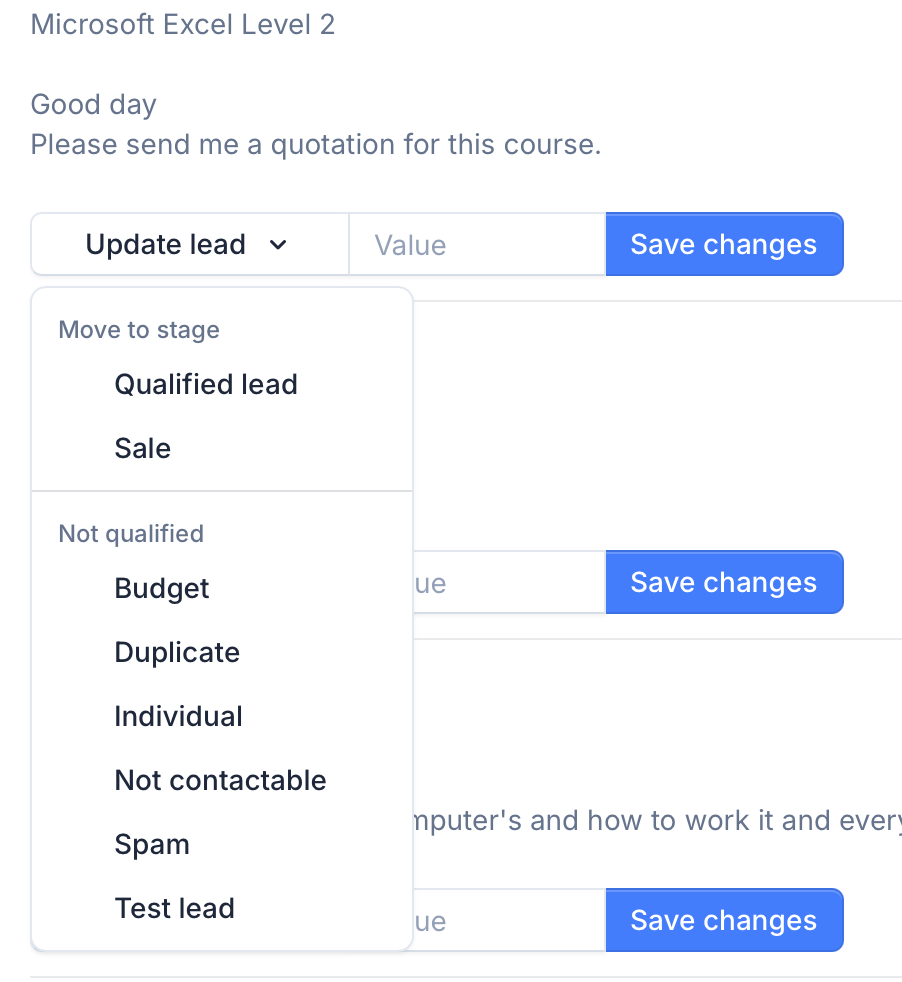
We already have a lead screen in Litiro where leads can be updated.

This works reasonably well for office-based teams, and we could improve the mobile experience further.

But it still requires people to log into another system. Even though it's easy, it’s still friction.
Uploading qualified leads as offline conversions

Update from existing tools

Another approach is to let people mark leads as qualified from tools they already use.

For example, email.

In some other tools I've built we put a qualified / not qualified button on the lead delivery email. It works well for form leads because you have context: name, enquiry and so on.

I've been thinking of adding this to Litiro. Here's how it would work.

Litiro is compatible with most contact forms. If you capture leads using say Typeform or Fluent Forms you'd disable the lead notification from the form system. When the lead arrived in Litiro it'd send the notification to your client along with the qualified / not qualified button instead.

This doesn't work as well for phone call leads though.

SMS follow-up

We're integrated with most call tracking systems like CallRail etc. That means we could trigger an SMS at the end of the call. It could include a link to mark the lead as qualified, or even something as simple as “reply yes if the lead was qualified.”

This would work for low-volume campaigns where one person handles all the calls from a mobile phone - perhaps an independent contractor. In a busier setup with a switchboard, it’d break.

Call-based prompts

Some call tracking systems allow you to mark a lead as qualified after the call ends.

In theory this is good, but in practice it can feel awkward. You can’t end the call naturally, you have to wait for the lead to hang up.

We could do something similar to the SMS but with a call. "Press 1 if the lead was qualified..."

But, like an SMS, this is more suited to low-volume setups.

Where this leaves us

If you can get feedback from real business events like quotes, bookings or sales, that’s by far the best option.

Everything else is a workaround.

That’s the problem I’ve been trying to solve with Litiro. I'm curious, how are you getting feedback from your clients?

Want to increase your conversion rate?
I’ve seen conversion rates double, triple and even 10X after a few quick and easy changes to the enquiry form. Subscribe now, and I'll send you a free copy of my in-depth ebook High-Converting Enquiry Forms.
You're already paying for clicks. Now turn them into conversions.

Related articles

Testing Google Ads for an RV Campground The goal was to spend a small amount, gather data, and see what actually happens. We got bookings, but the value distribution surprised me and changed how I'm going to structure this account.

Why your Google Ads leads suddenly turn to junk I helped with two struggling Google Ads accounts. The problems had different symptoms, but the root cause was the same.

The data gap between advertising and sales Many businesses can’t answer a basic question: Did this ad actually make us money? Why is something so important invisible inside the software that runs the business? The reason is simple. Advertising systems are designed to measure marketing activity. Business systems are designed to manage operations and finances. Neither system was designed to understand the full journey from ad click to revenue.

Why many RCICs don’t know if their Google Ads are profitable Google Ads can be a reliable source of new clients for Canadian immigration lawyers and consultants. The ads bring enquiries. But there is one question many firms can't answer: Are those leads actually turning into paying clients?

Why negative keywords are becoming less effective in Google Ads Adding negative keywords from the search terms report has always been part of diligent Google Ads management. But while it's still important, it's becoming less and less effective. Here's what's working for me today.

The invisible Google Ads problem: zero-second calls There is an invisible problem that could be draining your ad budget or causing you to miss sales. If you use a call tracking platform for call assets or landing page numbers, you might be at risk.

Why the phone rings but the workshop stays empty I spoke recently with my friend Liam Lezra, who knows more about marketing for auto repair shops than anyone I know. Our conversation turned to a problem he runs into often.

Most Google Ads Reports Focus on the Wrong Things Every month Google Ads agencies spend hours preparing reports for their clients. Most of them end up archived and unread. I think most of them focus on the wrong things. They describe what happened inside Google Ads, but say very little about what happened after the lead arrived.

What’s the right bidding strategy for a brand new Google Ads account? Some say you should start by focusing on clicks to build up data, others say that you should use a conversion-based bidding strategy from day one. Here are the exact settings and performance data from a recent launch

You can't run profitable Google Ads if your pipes are leaking You can't run profitable Google Ads without working plumbing - the systems that carry data from the website, to the business and back to Google. The problem is that the plumbing is invisible.

The problem with call duration conversions On the surface using call duration as a proxy for call quality is a reasonable idea. The thinking is that poor-fit leads or spam callers often hang up quickly. Good quality leads usually talk for longer. Put another way, a long call equals a good lead. But this isn't always true.

Computer code rusts It decays when people change things without understanding how systems are connected. And this makes life very difficult for anyone managing Google Ads. You end up basing important decisions on distorted data.

Helping people make better Google Ads decisions I advise a handful of agencies and in-house Google Ads teams. Over time, I’ve noticed a recurring problem creep in. Some people start outsourcing their critical thinking to me.

The campaign looks good but the ads aren't profitable The root cause is a data-gap. Ad data lives in Google. Business data lives in the office. I’m stuck in the middle, with no way of combining the data in a way that supports better decisions. I think we can change that.

Ignore the AI hype. Watch the engineering. Discussions about the future of Google Ads usually start with what’s announced: new features, calling everything Max-this or AI-that. But often this is PR hype. I prefer to look at where Google continues to invest engineering effort over many years. It gives a clue to what the system will depend on in the future.

Banging your head against the right problems Google Ads always has problems, but they’re not all the same: Some problems are cheap, some are expensive.Some affect one click, some affect every click. Some problems are in our control, some are in Google’s control.

My lead count doesn't match my conversion count The lead count from Google in your CRM almost never matches the number of conversions in your ad account. Trying to reconcile the difference is a shortcut to madness. Here's why.

Google Ads conversion tracking for WhatsApp orders If you accept WhatsApp orders on your e-commerce site, you face two problems: knowing where the orders came from, and tracking them as Google Ads conversions.

Google Ads conversion tracking for WhatsApp bookings If you accept WhatsApp bookings on your site, you face two problems: knowing where the bookings came from, and tracking them as Google Ads conversions.

When there are no good options in Google Ads When a well-built Google Ads campaign stops working, sometimes there’s no good way to fix it. Here’s how to handle that with honesty and care.

50% more leads… and still fired I delivered 50% more leads for a client—then got fired. Here’s why I won’t take responsibility for results without control of the landing pages.

Client selection: complexity is a red flag Anyone in a service business knows that some money is easy, and some costs blood. The difference isn’t the work, it’s the client. The key is spotting terrible clients early. Complex systems are a red flag.

Can Performance Max campaigns work for lead generation? Can Performance Max campaigns work for lead generation? In this article, I share how I tested PMax for a client whose search campaigns had reached their limits.

Why Managing Google Ads Is So Hard for People Who Care If you manage Google Ads for clients, you’ve probably wrestled with the urge to over-check, overthink or endlessly tinker with campaigns. I have too. Here’s what I’m doing to make the work more sustainable — and a little more sane.

61 leads. 3 sales. What went wrong? One morning, just after sunrise, I was out in the water when I saw a pair of sharks between me and the beach. This morning wasn’t quite so dramatic. I had time to think between waves. I was replaying a conversation I’d had with a grumpy client.

How to Track Which Google Ads Bring Paying SAAS Users If you're running Google Ads for your SaaS, it's not enough to track free trial signups — you need to know which ads are actually bringing in paying users.

How Many WhatsApp Clicks Turn Into Leads? You can track clicks on the WhatsApp button as conversions in Google Ads but you can't track leads. This results in overcounting how many clicks turn into leads. Inflated conversion numbers lead to overvaluing advertising and other problems. Here is some data...

How Adding Pricing to Google Ads Headlines Increased B2B Lead Qualification by 27% B2B advertisers often waste money on B2C leads. The thinking was that adding the price to the ad would deter individuals without scaring off B2B buyers.

PPC Burnout Is Real: How to Protect Yourself Running Google Ads for clients is stressful. Here are some ideas that might help avoid burnout.

Tracking Google Ads Without the Google Tag or Tag Manager Occasionally, I need to track Google Ads conversions without using the Google Tag or Google Tag Manager. Here’s a simple, non-technical explanation of how I do it.

Does broad match work for lead generation? A better question is When does broad match work for lead generation campaigns?

How I helped a client reduce their risk while scaling up a Google Ads campaign. Scaling up a successful Google Ads campaign by targeting new locations can risk your lead flow. Here's how I helped a client reduce this risk.

Tracking WhatsApp leads as conversions in Google Ads. There’s currently no built-in way to track WhatsApp leads as conversions in Google Ads. I've fixed this.

"Help. I'm Getting Calls For Competitors From My Google Ads." You're paying Google because you want lots of high-quality leads, not because you want a bunch of wrong-number calls.

Can you improve B2B lead quality by blocking free email addresses? Some say blocking free email addresses from B2B enquiry forms improves lead quality. Here's why I disagree.

Some ideas for improving B2B Google Ads. B2B Google Ads usually faces one of 2 problems: very little traffic, or lots of traffic - but most of it B2C. Here are some ideas to improve B2B Google Ads campaigns.

How I stop Spanish job-seeker leads from Google Ads Most Spanish job-seeker spam comes from click fraud. Here's how I stop it.

Data from launching a brand new campaign using Target CPA bidding. Normally you wouldn't launch a new campaign using a conversion-based bid strategy. I did, here's what happened.

A new Google Ads campaign needs deep data, not wide data. 100 clicks on 100 adverts tells you nothing. 100 clicks on 1 advert and a picture starts to emerge.

How I track WhatsApp conversations as conversions in Google Ads At the time of writing Google has no way of tracking WhatsApp leads as conversions. I've used a couple of work arounds to solve this.

Most Google Ads advice is wrong for small businesses A small account needs a different setup and different management. You see, something that improves a $50 000 a month account might tank a $500 a month account.

Modernising a Legacy Google Ads Account Without Breaking It A successful restructure leaves the account easier to understand, easier to optimise and better positioned for the future. Understanding why the account looks like it does is key to getting from sticky mess to well-oiled machine.

How I reduce wrong-business leads from Google Ads This is for you if you advertise on Google Ads and get leads who think they're contacting a different business. They call or fill in a form looking for someone else.

How I improve lead quality by telling Google which leads are good. By default Google Ads believes every lead is good. But that's not true. You can give Google feedback on lead quality and use that feedback to get better leads.

The shy introverts guide to finding clients Here's my approach for beating the feast-famine cycle.

How's your Chinese? Google shows English adverts to people who searched in Chinese even though the campaign language is set to English. Here's how you can stop this and why you might want to.

Is it safe to use broad match keywords for lead generation campaigns? Google is pushing broad match hard and, some people are reporting good results. But, is it actually best practice now? Or are broad match keywords a waste of money?

Should I split a massive multi-country Google Ads account into separate accounts? At first glance it seems like splitting a big account into smaller accounts will make it easier to manage. But, there are downsides and, there are ways to make big accounts easier to manage.

Why did Google charge me $300 for a $20 click? Every now and again Google would charge an outrageous amount for one click. As much as 15 to 20 times what they normally paid. Here's how to prevent that.

An easier way to sell services. Bigger value projects take a lot of work to sell. You have to have the discovery calls, meeting notes, customised proposals and quotes. And, you often need several follow-up meetings. There is another way.

Why I don't just delete fake leads from my inbox If the only thing you do with fake leads from Google Ads is delete the lead delivery email you risk getting swamped by fake leads. Here's why and what to do to improve lead quality.

Grow your own big-budget clients Building a profitable agency or freelancing with small-budget clients is hard. Here's how to grow your smaller clients into bigger-budget clients.

Getting a lot of junk leads from Google Ads? You can spot conversion fraud because the leads have genuine email addresses and phone numbers but when you call them they don't remember filling in your form.

My client fired me, and now he’s asking for my secret sauce. A client fired you even though you were doing a good job. Here's how to make this sting less and keep the door open for future work.

You can optimise your client's business like you optimise their Google Ads account. You can give your client a much bigger ROI by optimising their business than almost anything you can do in their Google Ads account. Here's how.

How to handle your client's terrible ideas. Your client has a terrible idea for "improving" the campaign. If you push back you're going to lose the client. Here's how to keep the client without killing the campaign.

Google Reps You may get an email or call from someone claiming to work at Google. They’ll tell call themselves an account representative, strategist, advisor or account manager. You and I would call them salesmen.

Guaranteeing Google Ads. It’s uncomfortable when a potential client asks me if I guarantee that they’ll make sales from their Google Ads. In the past my first instinct was to run away. I thought that asking for a guarantee was a sure sign that they’re going to be a toxic client. I was wrong.

How do you convince a potential client to trust you if you don’t have a track record? How do you convince a potential client to trust you if you don’t have a track record? This happens a lot when people go out on their own after working in-house or for an agency. Read on to find out how I solved this problem.

How to make OK money from small clients You have to work with the clients you can get, not the ones you hope for. Sometimes you might not be able to attract big-budget clients. Here's how to do OK with smaller clients.

How to take over an existing Google Ads account. You’ve taken over a Google Ads account that’s in trouble. You're going to turn it around - more conversions, lower costs, 10 quality scores etc. There’s a lot riding on getting this right...

Optimise your words There are a handful of non-PPC tools I'd hate to run my Google Ads business without. Hemingway is one.

Resources for Google Ads agencies and freelancers. Tools, reading lists and discussion groups for digital marketing agencies and freelancers offering Google Ads as a service.

Should I specialise or be a generalist? I often get asked whether it’s best to specialise or be a generalist. I understand why but I think it's the wrong question. I think a better question is ...

The AdLeg Google Ads Software Suite. I interviewed Kyle Sulerud, creator of the AdLeg Software Suite about how he started in Google Ads (AdWords) and why he built his Google Ads creation and management software.

I've inherited a mess. Crazy structure, gibberish naming convention and 22 conversion actions that might or might not mean anything. Here is a collection of principles, tips and ideas for when you inherit a messy Google Ads account.

A love letter to statistics This is for you if you’re interested in making data-driven decisions about your Google Ads. Amy Hebdon, founder at Paid Search Magic, wrote a fantastic article she described a love letter disguised as a how to about PPC data interpretation.

Allocating budget How do you know the best way to split your ad budget between search and display, between Facebook and Google, between one keyword and another?

Does Google rip advertisers off? I'm not saying that everyone who's paid for Google ads has turned a profit. That's definitely not the case. But, when people lose money on Google ads its likely to be because Google Ads was a poor fit for their business, or because of the way they did Google Ads. I can't see Google risking their future to steal your advertising budget

Don’t believe every recommendation from Google. The optimisation score is Google’s newest way of telling you how to run your Google Ads account. Read on to see how following it blindly can hurt your business.

Don't believe my writing I'm not trying to bamboozle you, it's just that my - and everyone else's - writing isn't always right for your circumstances. Read on to find out more...

Google showed your ads to the wrong people today. Google showed your some of your adverts to the wrong people today. You (or someone you hire) must deal with this or your ads are going to start costing more and generating fewer leads. Here's how.

Has Google jumped the gun on mobile? How much commercial activity happens on mobile phones? Is it enough to justify a mobile-first approach to development? Case study with mobile vs desktop AdWords generated leads across 7 industries.

How do you get more leads from Google Ads when you’ve maxed out impression share? How do you get more leads from Google Ads when you’ve maxed out impression share? Here's how we solved this problem...

How to get fast traction on a brand new Google Ads campaign. I worked out a process for getting fast results from new AdWords campaigns so I didn't have to worry as much. You're welcome to copy (and improve) my process.

I’m getting too many B2C leads. I want only B2B. I’ve bumped into this problem with almost every client who sells to other businesses (B2B) not to consumers (B2C). Here are some options ..

I'm scared I'll break my campaign If you don't feel confident making changes to Google Ads campaigns this might help...

Improve conversion rates by adding extra calls to action. Need to improve your conversion rate? Here's a tested approach that takes only a few minutes.

Putting a little science into AdWords In the past I relied on a combination of the change history in AdWords, some rough notes and my memory to keep track of my testing. It worked but it wasn't great. It became more difficult as my business grew. I started to feel like I was losing control. I couldn't answer questions about an account without having to root around in Google docs, AdWords and email. Read on to see how I fixed this.

Should you advertise on Search Partners? We check the campaigns we manage regularly to see how much it costs to generate an enquiry on Google search versus search partners. Most of the time it costs more or less the same. Sometimes the difference is huge.

Should you show ads to people on their phones? It is a fact that more people use the internet on their phones than they do on computers these days. But are these glued-to-their-phone types going to buy from you?

The hidden trade-offs of automated bidding I like automated bidding. But, there are some trade offs with automated bidding that are not well documented.

Using the Search Terms Report to find negative keywords. The Search Terms Report is a great place to find negative keywords to add to your AdWords campaign. It shows (some of) the actual words and phrases that triggered your ads.

You don't have enough data to be confident that you're making the right decisions. Here are 3 rules of thumb I use to to help me make more of the right decisions when data is scarce.