How to make accepting your quote feel like the safe choice
For permanent decisions, prospects care less about getting the best deal than avoiding a terrible mistake.
Published April 2024. Last updated July 2026.
25% to 50% of leads don't turn into customers because they don't speak to a sales person. The lead filled in an enquiry form but nobody could get them on the phone.
Speaking to more of your leads is the easiest way to increase sales without having to spend more on ads.
The first contact email sequence is the easiest way to increase the number of leads you speak to. It takes an hour to set up and runs mostly on autopilot after that. It's one of the first things I do with my clients after we've got their ads producing leads.
Here's what a client said about a week after we started. (Please excuse her excessive use of emojis, she's young.)
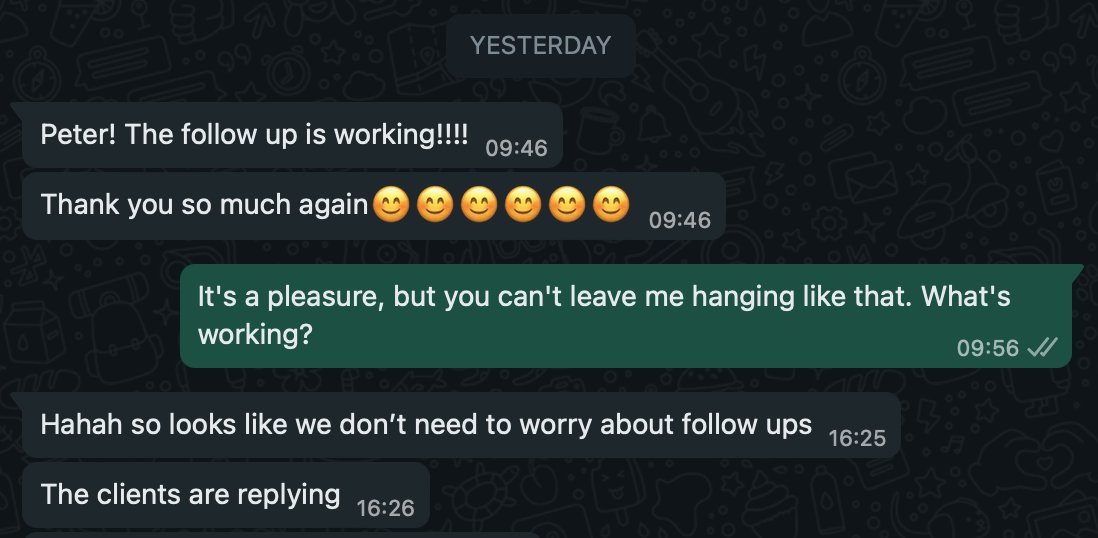
(If you can't see the picture, it's a screenshot of a WhatsApp conversation where my client says "Peter! The follow up is working" followed by lots of exclamation marks and six smiley faces.)
The first contact email sequence is a series of pre-written emails that start when the lead arrives and get sent as intervals after that.
The sequence stops when a sales person speaks with the lead or after the last message has been sent.
I like to send messages with fewer days between messages at the start of the sequence and longer interval later. That's because the lead is most interested at the time they enquired. Their interest (and our chance of making contact) wanes with time.
Here's my go to cadence:-
You could go wild and write a longer series but if you haven't made contact after 28 days the lead is as good as lost.
I like to include the following in every message:-
I've recently started using ChatGPT to get past staring at a blank screen wondering what to say. Here's the prompt I modify for each client to get a rough first draft. You're welcome to borrow it.
Please write 6 follow-up email messages. The messages are to be sent over the course of a month to people who contact our business through a form on our website. Our business is an immigration law firm. Please include the following in the email messages. 1. The reason for the email. 2. A way to unsubscribe. 3. Tell them that someone from the office will try call them. 4. Tell them they can contact us during office hours 08:00 - 17:00 on weekdays and 08:00 - 13:00 on Saturday on our main number 555-555-555. Tell them they can contact us by email to this address.
Here’s a link to the raw ChatGPT output from the prompt above. It definitely needs some polish but it’s not a bad starting point.
Any modern CRM system should allow you to automate a series of emails. If your's doesn't you might be able to rig something up using Zapier and an email service like Kit.
You also need a way to stop the sequence after you've spoken to the lead because it doesn't make sense to send them an email about not being able to contact them after you have contacted them.

For permanent decisions, prospects care less about getting the best deal than avoiding a terrible mistake.
I’ve long believed Google Ads is only profitable when the processes around it work. One of the most important is how quotes turn into sales.
Many businesses can’t answer a basic question: Did this ad actually make us money? Why is something so important invisible inside the software that runs the business? The reason is simple. Advertising systems are designed to measure marketing activity. Business systems are designed to manage operations and finances. Neither system was designed to understand the full journey from ad click to revenue.
Google Ads can be a reliable source of new clients for Canadian immigration lawyers and consultants. The ads bring enquiries. But there is one question many firms can't answer: Are those leads actually turning into paying clients?
There is an invisible problem that could be draining your ad budget or causing you to miss sales. If you use a call tracking platform for call assets or landing page numbers, you might be at risk.
I spoke recently with my friend Liam Lezra, who knows more about marketing for auto repair shops than anyone I know. Our conversation turned to a problem he runs into often.
Thoughts and lessons on client selection, burnout, pricing, and modernising legacy accounts, from someone who's run a Google Ads for years.
Understand what happens after someone clicks your advert. Subjects include offline conversions, CRM integration, attribution, auditability and marketing instrumentation.
Articles about marketing, engineering, AI and problem solving that don't fit neatly into the other topics. These are some of the ideas and experiences that have shaped how I think.
How to choose the right Google Ads agency, set them up to succeed, judge their work fairly, and build a relationship that delivers better business results.
Learn how to use Google Ads to generate profitable leads. Subjects include campaign strategy, bidding, targeting, optimisation and the challenges of running lead generation campaigns.
Understand why some leads become customers while others don't. Subjects include diagnosing poor leads, qualification, filtering junk leads and improving the feedback you send to Google Ads.
Things I've learned about high-converting landing pages. Subjects include copywriting, page structure, forms, trust, conversion rate optimisation and user experience.
What happens after a lead has been generated determines if Google Ads is profitable. Subjects include first contact, follow-up, quoting, lead nurturing and turning more enquiries into customers.