Agency insights
Thoughts and lessons on client selection, burnout, pricing, and modernising legacy accounts, from someone who's run a Google Ads for years.
Published October 2026. Last updated October 2026.
My wife and I have six children between us. Four mine, two hers. We often joke about how incompatible my South African parenting is with her British approach.
South Africans know that the right age for a child to get their first axe is when they can pick it up. You can imagine how well that goes down.
We met after the kids were older, so we never had to have the axe talk. I don't think wifey and I would have agreed on axes or how much freedom to give kids, and when they’re ready for it.
Managing Google Ads raises a similar question: how much freedom should I give Google, and when should I give it more?
I'm thinking of two kinds of freedom here:
Google already has the first. Even with exact match keywords, negative keywords and tight location targeting, Google pretty much shows your ads to anyone they want.
We still decide the second - what the ads say. But Google is doing their best to change that.
But, for now, we can still decide exactly what the ads say. And I'm very happy about that. Let me tell you why.
I recently launched a pilot campaign for an auto body shop in Jacksonville, Florida.
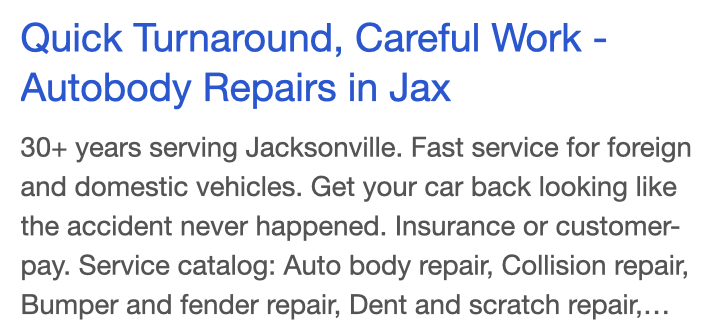
But, when I checked the search terms report, I found:
autobody shop tallahassee
Tallahassee is about 165 miles from Jacksonville. Two and a half hours’ drive. How likely is it that this person wanted a body shop in Jacksonville?
Google showed the ad anyway.
Luckily, nobody clicked.
I suspect including the location in the ad helped. It gave the person a chance to see that we weren’t what they wanted before spending my client’s money.
That’s part of an ad’s job.
We tend to think of ads as a way of persuading people to click. But a good ad also stops the wrong people clicking.
“Jacksonville” attracts people looking for a body shop in Jacksonville. It also warns someone looking for Tallahassee that we're not right for them.
Google got the first decision wrong: who to show the ad to. But because I controlled what the ad said, we didn't pay for a rubbish click.
So what happens when Google gets the matching wrong and then writes an ad to fit that mistake?
Imagine if, for that same search, Google magicked up a headline saying “Auto Body Shop Tallahassee”.
The person might have clicked.
This search came on day two of the pilot campaign. We'd only had five leads at this stage.
That's not enough data for me to be comfortable giving Google room to experiment with ad copy. Later, when we've got a solid idea of what brings in good quality leads, I might allow Google a little more freedom.
But for now, I don't want to risk compounding intent-matching mistakes with ad copy mistakes.
If you like the way I think I'd like to give you a copy of my book Profitable Google Ads. You can download it right now at https://pete-bowen.com/book

If nobody can help your leads, why keep paying for them? Here’s what I’ve seen after years of pausing and restarting clients’ Google Ads.
It is almost always cheaper to get a happy customer to return than to win another one through advertising.
If every enquiry looks equally valuable, Google will chase quantity. Does it ever learn which leads actually become customers?
I trace every route from the ad to the CRM to find leads and tracking data that go missing.
The ad account says the leads are good. The sales team says they aren’t. Who has the evidence needed to decide?
Finding problems is easy. The difficult part is identifying the few evidence gaps that could materially affect leads, decisions and profitability.
Thoughts and lessons on client selection, burnout, pricing, and modernising legacy accounts, from someone who's run a Google Ads for years.
Understand what happens after someone clicks your advert. Subjects include offline conversions, CRM integration, attribution, auditability and marketing instrumentation.
Articles about marketing, engineering, AI and problem solving that don't fit neatly into the other topics. These are some of the ideas and experiences that have shaped how I think.
How to choose the right Google Ads agency, set them up to succeed, judge their work fairly, and build a relationship that delivers better business results.
Learn how to use Google Ads to generate profitable leads. Subjects include campaign strategy, bidding, targeting, optimisation and the challenges of running lead generation campaigns.
Understand why some leads become customers while others don't. Subjects include diagnosing poor leads, qualification, filtering junk leads and improving the feedback you send to Google Ads.
Things I've learned about high-converting landing pages. Subjects include copywriting, page structure, forms, trust, conversion rate optimisation and user experience.
What happens after a lead has been generated determines if Google Ads is profitable. Subjects include first contact, follow-up, quoting, lead nurturing and turning more enquiries into customers.