Agency insights
Thoughts and lessons on client selection, burnout, pricing, and modernising legacy accounts, from someone who's run a Google Ads for years.
Published July 2026. Last updated July 2026.
I got involved in a Google Ads conversion tracking problem.
The client runs a taxi service. They've got a fairly typical setup. Someone clicks on an ad, books a taxi through a widget on the site and then pays by card.
The booking ends up in Hubspot. And the widget reports it as a conversion via Google Tag Manager.
The problem was that the booking count and value in Google Ads was very different to what's in Hubspot.
Matching lead count in a CRM to conversions in Google Ads is always difficult. In this case there are a few more challenges:
Patchy mobile internet means that sometimes successful bookings don't get recorded as conversions.
Cancellations or changes don't update the conversion count or value.
The widget validates the card and confirms the booking but the customer's bank still has to complete the transaction. Most of the time that's fine, but occasionally a card is declined a few minutes later. Again this doesn't change the conversion count or value.
In this past these discrepancies weren't a big deal, because Google used keywords as its main signal. Today with smart bidding conversion signals like leads or bookings take priority over whether someone typed in "taxi near me" or "airport taxi service".
That makes the quality of the conversion signal as important as anything else in the ad account. You don't want Google learning from incomplete or incorrect signals.
I think this is where browser-based conversion tracking starts to show its limitations. Google learns from what the browser sent at that moment. That's not always what ultimately happened.
You want Google Ads optimising for conversion signals that are:
Using offline conversions makes it possible to tick these boxes.
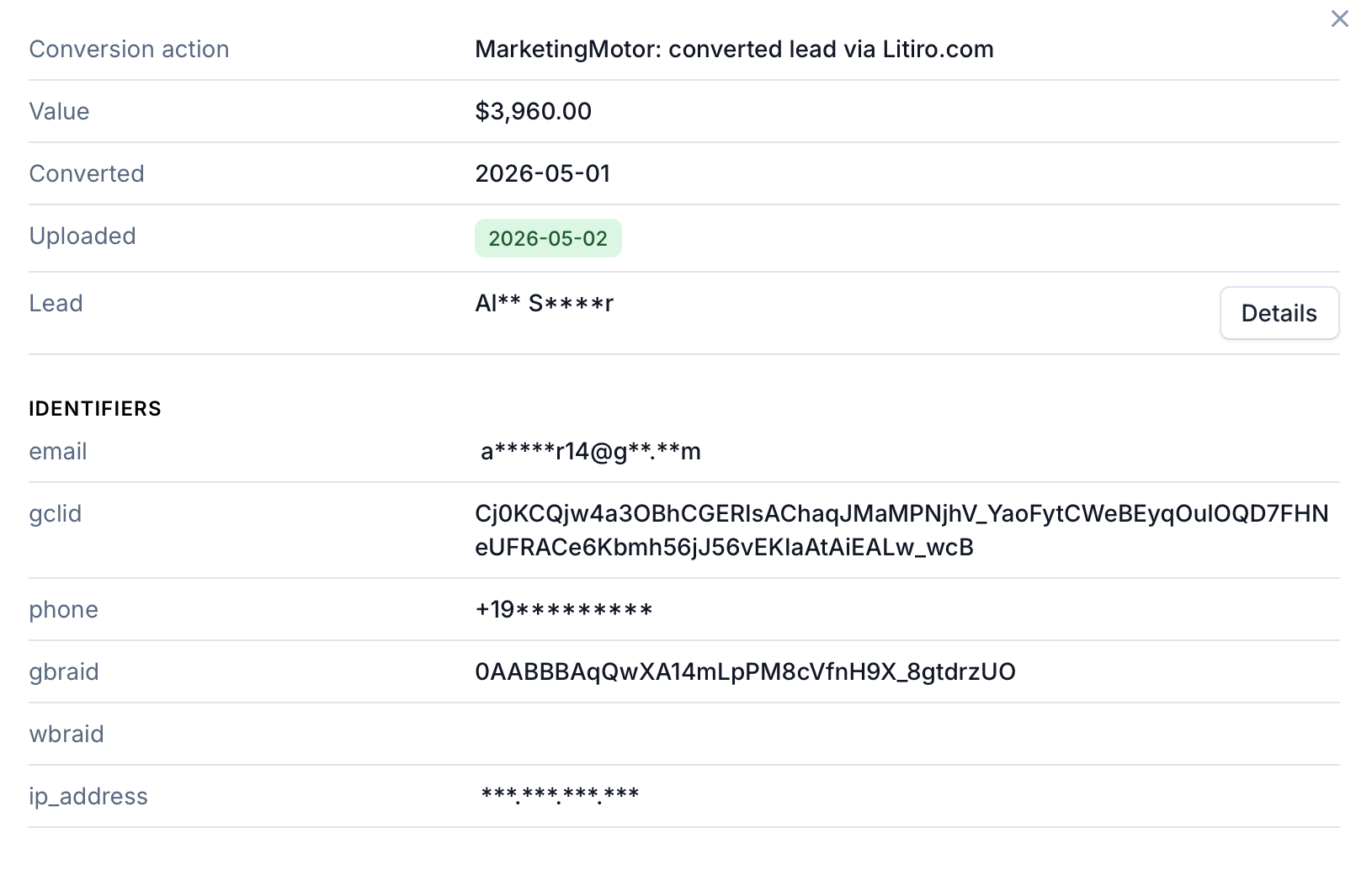
For example, here's a screenshot (from a different client) which shows which conversion was uploaded and what was data was sent to Google. If something looks wrong, I have somewhere to start investigating.
Traditionally, offline conversions were used for down-funnel events like qualified leads, booked appointments and sales.
I take a slightly different approach. I use them for everything, including first-contact events like form submissions, phone calls and WhatsApp messages.
Having one system accountable for all conversions makes monitoring easier and saves me looking for answers in three different places if something goes wrong.
Going back to the taxi company. Google and HubSpot showing different numbers is annoying. But the real problem is that Google was learning from a version of events that isn't always true.
I think this is becoming more of a factor in ad profitability than most people realise.
We put a lot of effort into monitoring things like budget pacing, landing page uptime and so on. I think conversion signals deserve the same degree of care.

How to give Google Ads cleaner feedback about lead quality.
I send conversion data more slowly in exchange for data that's permanent, auditable and recoverable.
Connect Pipedrive to Google Ads and fix the offline conversion gap automatically, in about 30 minutes.
Contact Form 7 is one of the most popular form plugins for WordPress. But, if you're running Google Ads, there is a problem. Contact Form 7 can tell you that somebody submitted a form. It can't tell Google Ads if that person became a customer.
Here's the complete guide to tracking WhatsApp conversions from click to sale.
Fluent Forms is a great way to capture leads from a WordPress website. But if you run Google Ads there is a gap in the system. Google can see the click and it can see the form submission. But it can't see what happens after the lead arrives. Here's how I helped a client close that gap.
Thoughts and lessons on client selection, burnout, pricing, and modernising legacy accounts, from someone who's run a Google Ads for years.
Understand what happens after someone clicks your advert. Subjects include offline conversions, CRM integration, attribution, auditability and marketing instrumentation.
Articles about marketing, engineering, AI and problem solving that don't fit neatly into the other topics. These are some of the ideas and experiences that have shaped how I think.
How to choose the right Google Ads agency, set them up to succeed, judge their work fairly, and build a relationship that delivers better business results.
Learn how to use Google Ads to generate profitable leads. Subjects include campaign strategy, bidding, targeting, optimisation and the challenges of running lead generation campaigns.
Understand why some leads become customers while others don't. Subjects include diagnosing poor leads, qualification, filtering junk leads and improving the feedback you send to Google Ads.
Things I've learned about high-converting landing pages. Subjects include copywriting, page structure, forms, trust, conversion rate optimisation and user experience.
What happens after a lead has been generated determines if Google Ads is profitable. Subjects include first contact, follow-up, quoting, lead nurturing and turning more enquiries into customers.