Too cheap to trust?
You see a better price and faster service. Your customer might see cutting corners.
Published November 2026. Last updated November 2026.
Want cheaper leads? Improve your landing page conversion rate.
This is hardly groundbreaking insight. But it's kept me up at night.
For almost 20 years, I've tried to figure out why someone would click a Google Ad and then not contact the business. And what we could do to get more of those clicks to turn into leads.
For years, I evaluated landing pages against a set of best practices. But many of those best practices are now table stakes. Everybody knows your page needs to be fast, look good on a phone, have a clear headline and a prominent call to action.
Later, I understood the importance of message match. Making sure that what was promised in the ad gets delivered by the page.
About two years ago, I thought I had it completely figured out. (Spoiler: I didn't.) I realised out that before a visitor would contact the business, they needed to believe four things:
That changed the way I build and evaluate landing pages. Instead of just checking the page against a list of best practices and checking that the message was consistent with the ad, I also asked if it created these beliefs.
For example, best practice says a page needs a clear, easy-to-read headline. But does the headline create the belief that, yes, you do what I'm looking for?
But I'd missed something about that first belief.
I've got a client who installs seamless aluminium gutters on houses.
People typically search for gutters for one of three reasons:
All three could search Google for "seamless gutter contractor", see the same ad and arrive on the same landing page.
The headline "Gutter Installation in Jacksonville Florida and Surrounding Areas" confirms that they've found a company offering the service they're looking for.
But the person who needs a repair still has questions. Do you take on small jobs? Can you match the colour and profile of my existing gutters?
This is what I'd missed about the first belief: it has two parts.
I call this reason match — matching the landing page to the reason someone was searching in the first place.
With gutters, it's easy. There are only three reasons. But it can be much more complicated.
Another client provides audiovisual equipment and technical support for corporate events.
We don't know what type of event someone is organising till they contact him. It could be almost anything: a conference, a product launch, a party, a meeting, a training event, an exhibition or an awards ceremony.
It gets muddier.
Consider four people organising a conference:
All four could follow exactly the same path from Google to my client's landing page. (Please forgive the AI image. ChatGPT is better at this than me.)
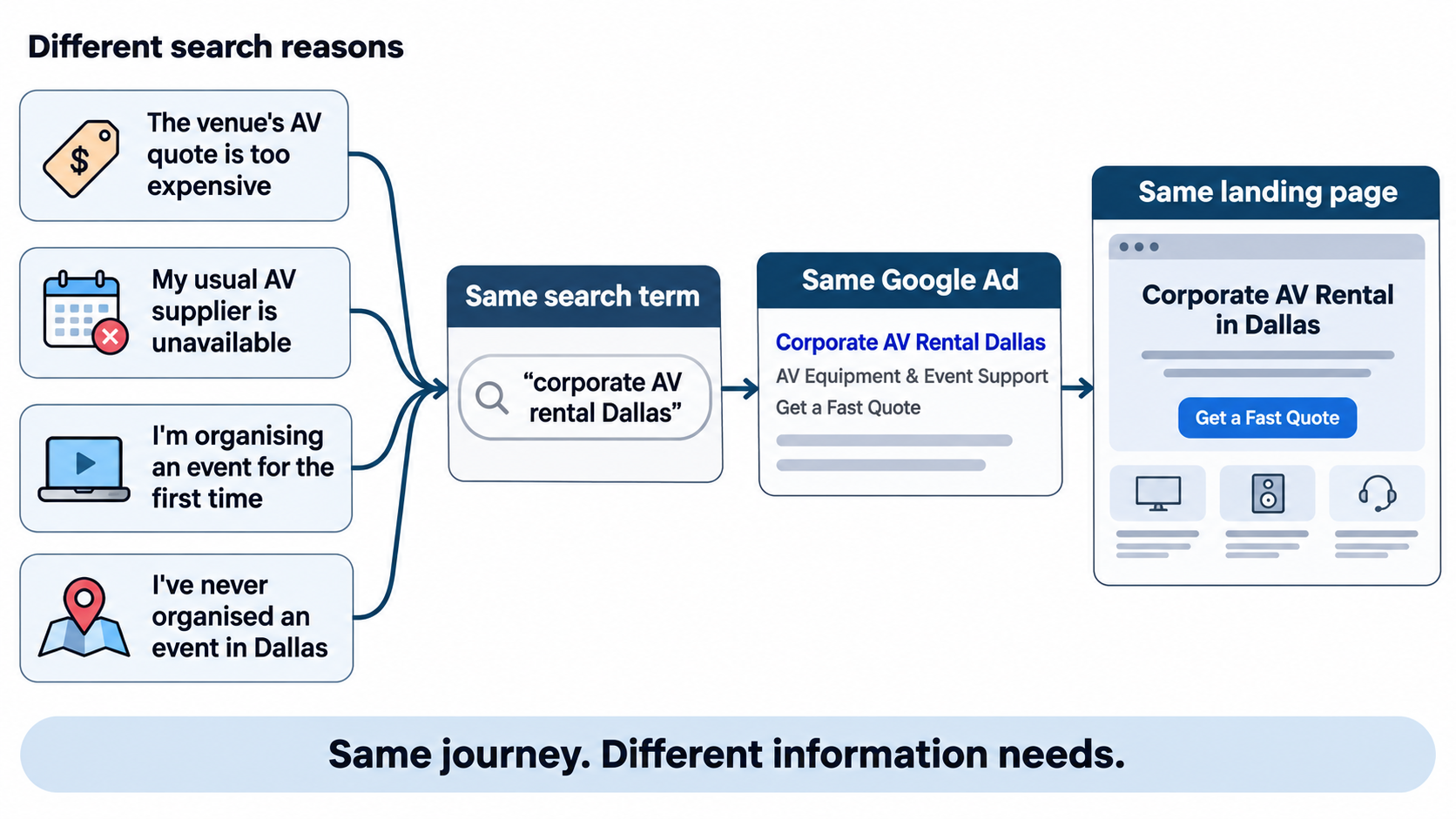
Each needs to believe something slightly different before they'll think it's worthwhile contacting my client.
The venue's AV quote is too expensive.
You can provide an alternative to the venue's AV supplier.
Their usual supplier is unavailable.
You can accommodate my event at short notice.
They're organising their first conference.
You can help me work out what equipment and technical support I need.
They've never organised an event in Dallas.
You can take care of the local AV logistics.
A landing page could do an excellent job of convincing one of these people but leave the others with unanswered questions.
Of course, people don't need every question answered before they'll contact a business. They just need enough reason to believe it's worth getting in touch. But the better our reason match, the more likely we are to give them that encouragement.
Start by finding out why people are searching. Read the enquiries submitted through your website, listen to recordings of initial phone calls and talk to the people who deal with enquiries. Pay particular attention to how potential customers describe their circumstances.
If there are lots of different reasons people search for your service, prioritise those that tend to lead to the kind of work you want more of.
Then, for each search reason, ask yourself two questions:
Sometimes it doesn't take much. Here's what the top of my gutter client's landing page looks like now.
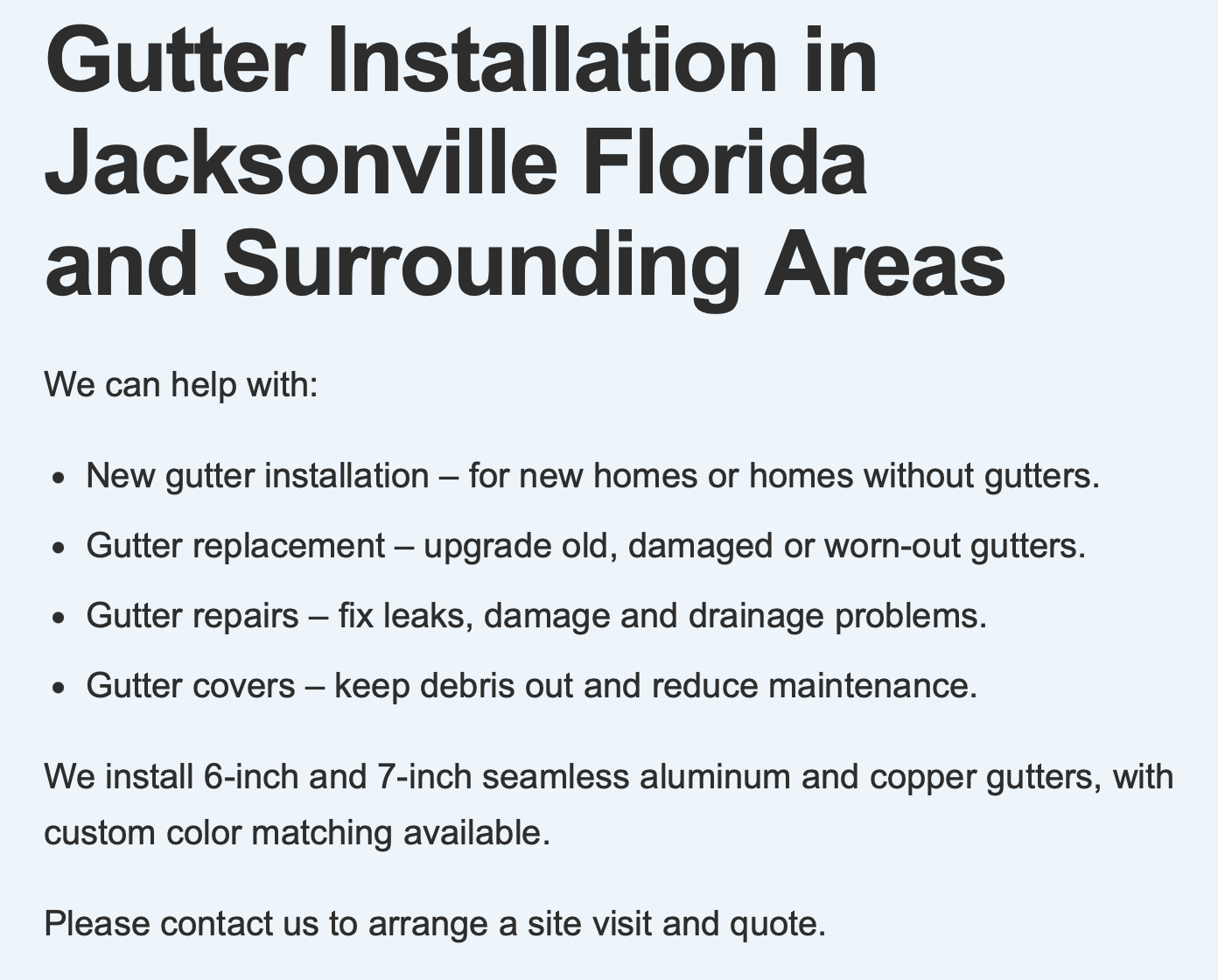
Anyone landing here knows the business does new installations, replacements and repairs.
In the case of gutters, a few words near the top of the page might be enough to convince someone that my client can help them.
Other circumstances might require a bit more persuasion. For example, someone who's unhappy with the venue's AV quote might not even know they're allowed to bring in an outside AV supplier. We could explain how this works and show them an example of an event where my client has done it.
This is also a useful way of deciding which testimonials, photographs and case studies to put on your landing page. Choose them based on what you need potential customers to believe.
Reason match doesn't replace landing page best practices or message match. It builds on them. If you've already got those things right, reason match gives you somewhere else to look for opportunities to get more leads without spending more on ads.

You see a better price and faster service. Your customer might see cutting corners.
You get the best results when you match your ad's hook to the landing page
Before a stranger will convert to a lead they need to believe four things.
Coming up with ideas for an interesting company profile is hard. Here's how to avoid staring at an empty screen.
2FA can reduce contact form spam—but it adds friction, risks real leads, and opens the door to scams like SMS pumping.
When people are looking into a product or service they rarely need they need to be confident about three things before they’ll work with you: That you actually understand what they need. That you have the competence to do what they need. That working with you won’t be a nightmare.
Thoughts and lessons on client selection, burnout, pricing, and modernising legacy accounts, from someone who's run a Google Ads for years.
Understand what happens after someone clicks your advert. Subjects include offline conversions, CRM integration, attribution, auditability and marketing instrumentation.
Articles about marketing, engineering, AI and problem solving that don't fit neatly into the other topics. These are some of the ideas and experiences that have shaped how I think.
How to choose the right Google Ads agency, set them up to succeed, judge their work fairly, and build a relationship that delivers better business results.
Learn how to use Google Ads to generate profitable leads. Subjects include campaign strategy, bidding, targeting, optimisation and the challenges of running lead generation campaigns.
Understand why some leads become customers while others don't. Subjects include diagnosing poor leads, qualification, filtering junk leads and improving the feedback you send to Google Ads.
Things I've learned about high-converting landing pages. Subjects include copywriting, page structure, forms, trust, conversion rate optimisation and user experience.
What happens after a lead has been generated determines if Google Ads is profitable. Subjects include first contact, follow-up, quoting, lead nurturing and turning more enquiries into customers.