Too cheap to trust?
You see a better price and faster service. Your customer might see cutting corners.
Published July 2024. Last updated July 2026.
...drops his head in shame...
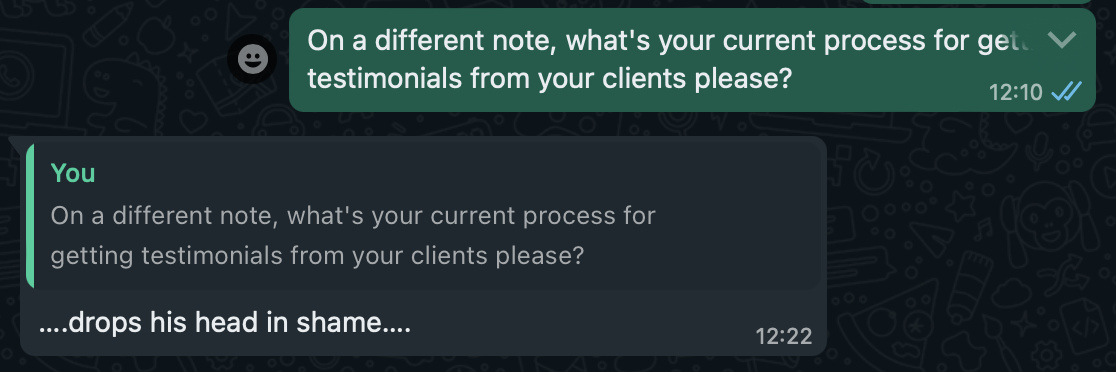
That's how a new client responded when I asked him about his process for getting testimonials.
He does great work, and gets a lot of referrals, but we didn't have much to put on his landing pages to prove it.
Testimonials reduce the fear of doing business with you. They make it easier for strangers to trust you. They can be the difference between getting a lead or not. They can be the difference between getting a new customer or not.
But, most people don't have a library of great testimonials. They either don't ask for them, or the testimonials they get aren't very effective.
I figured it was my job to fix this for my clients.
The best way to ask for a testimonial is to automate the asking. That way nobody has to remember to do it.
You might be able to do this from your customer management system. If you can't, the next best thing is to add an item to the list of work you do at the end of a contract.
I added a 'Request a testimonial' button to the CRM system I give all my clients. Clicking the button sends a pre-written email to their customer.
My thinking on what makes a testimonal effective started with an article by Sean D'Souza.
He says that most testimonials are 'sugary'. They're all about how good the business is and that makes them boring and less effective.
He describes effective testimonials as stories.
Stories don't start with 'And they lived happily ever after'. They start with some difficulty or challenge that the hero has to overcome.
Overcoming the difficulty is what makes the story interesting. It's the same with a testimonial.
A good testimonial starts with the doubts and hesitation the customer had about choosing you. Then it describes what it was like working with you. It finishes with the happy outcome and a recommendation.
But, your customers (probably) aren't writers. Unless you help them, they're going to give you a typical testimonial:
She's a great person and the work was good and nice.
Sean D'Souza suggests asking questions that lead to the customer telling a story. Here are his questions:-
What was the obstacle in your mind/hesitation before buying this product/service?
What did you find as a result of buying this product/service?
What specific feature did you like most about this product/service?
What would be three other benefits about this product/service?
Would you recommend this product/service? If so, why?
Is there anything you’d like to add?
I've used a version of these questions in the past, but I found that the resulting testimonials didn't read well. I got more natural comments when I changed the questions into prompts. For example...

You see a better price and faster service. Your customer might see cutting corners.
You get the best results when you match your ad's hook to the landing page
Before a stranger will convert to a lead they need to believe four things.
Coming up with ideas for an interesting company profile is hard. Here's how to avoid staring at an empty screen.
2FA can reduce contact form spam—but it adds friction, risks real leads, and opens the door to scams like SMS pumping.
When people are looking into a product or service they rarely need they need to be confident about three things before they’ll work with you: That you actually understand what they need. That you have the competence to do what they need. That working with you won’t be a nightmare.
Thoughts and lessons on client selection, burnout, pricing, and modernising legacy accounts, from someone who's run a Google Ads for years.
Understand what happens after someone clicks your advert. Subjects include offline conversions, CRM integration, attribution, auditability and marketing instrumentation.
Articles about marketing, engineering, AI and problem solving that don't fit neatly into the other topics. These are some of the ideas and experiences that have shaped how I think.
How to choose the right Google Ads agency, set them up to succeed, judge their work fairly, and build a relationship that delivers better business results.
Learn how to use Google Ads to generate profitable leads. Subjects include campaign strategy, bidding, targeting, optimisation and the challenges of running lead generation campaigns.
Understand why some leads become customers while others don't. Subjects include diagnosing poor leads, qualification, filtering junk leads and improving the feedback you send to Google Ads.
Things I've learned about high-converting landing pages. Subjects include copywriting, page structure, forms, trust, conversion rate optimisation and user experience.
What happens after a lead has been generated determines if Google Ads is profitable. Subjects include first contact, follow-up, quoting, lead nurturing and turning more enquiries into customers.