Agency insights
Thoughts and lessons on client selection, burnout, pricing, and modernising legacy accounts, from someone who's run a Google Ads for years.
Published November 2023. Last updated July 2026.
Losing potential sales always hurts. But, if you know why you lost the sale you can make changes that'll help you win more sales down the line.
The "Why we lost sales" report is one of the tools I use to help my clients make more sales to their Google Ads leads. The report shows how many leads didn't turn into a sale, and why.
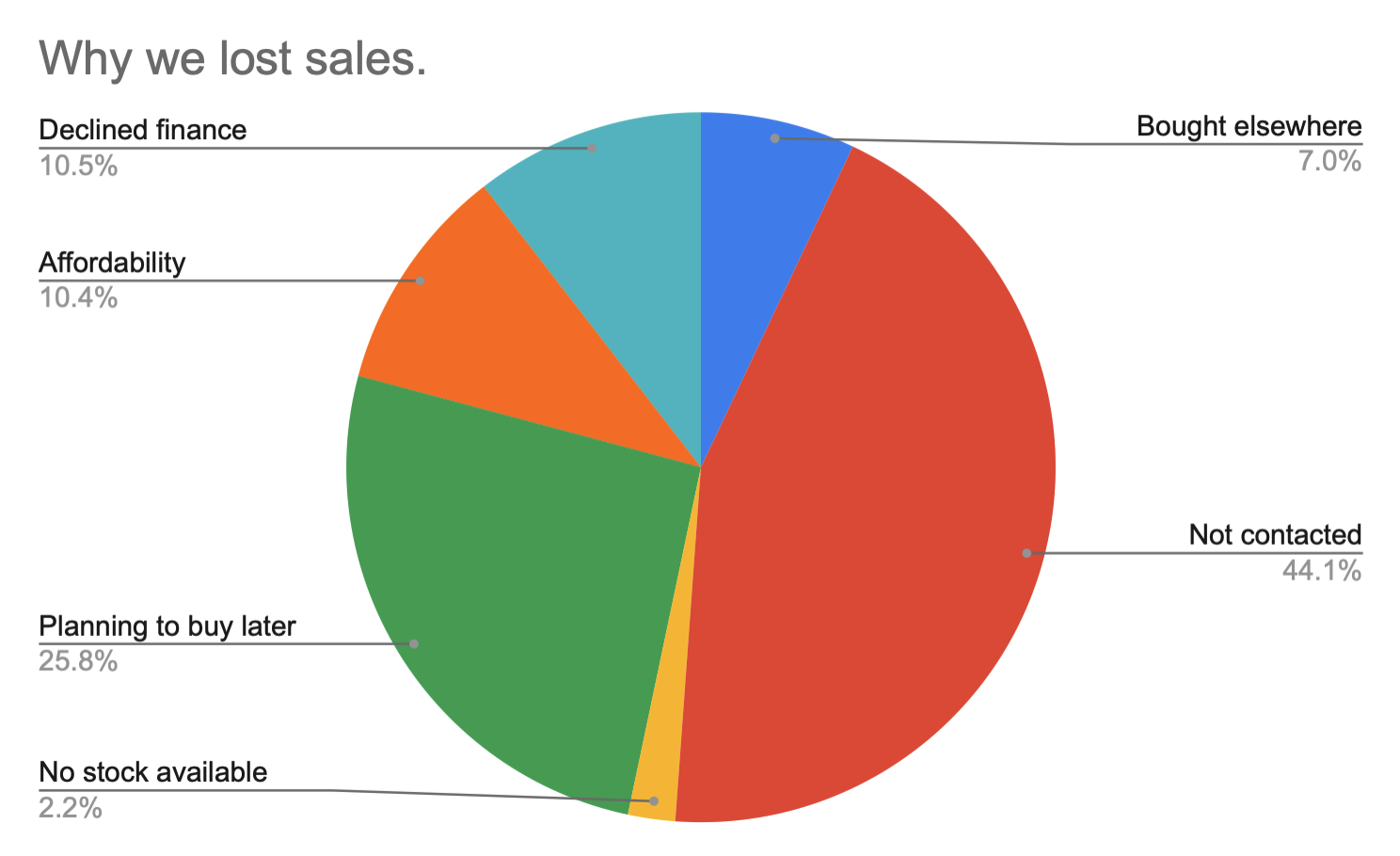
Here's the data for a few months from a business that sells new and used cars. The pie chart above represents the same data.
| Reason | Leads | Percentage of Total |
|---|---|---|
| Not contacted | 12703 | 44% |
| Planning to buy later | 7443 | 26% |
| Affordability | 2985 | 10% |
| Declined finance | 3021 | 10% |
| Bought elsewhere | 2030 | 7% |
| No stock available | 620 | 2% |
These leads never spoke to a sales person after completing an enquiry form. At 45% of all lost sales this represents the biggest opportunity to improve. Fixing this problem is worth several million a year and it's something we're currently working on.
These leads are in the research phase. They're looking at what's available in the market but they're not planning on buying right now.
At 25% of lost sales it is a big enough opportunity to justify some effort. The current plan is to use a combination of email marketing and phone calls to keep in touch. The aim is to get them to bring their decision to buy a car forward, and, to come directly to the business when they're ready.
We'll have the sales person introduce the idea of keeping in contact by saying something like
I know you're not ready to buy right now and that's fine. Occasionally we have very good deals available - where we've overstocked, or where the manufacturer is running a special. That kind of thing. One of those might work for you. Would you like me to let you know when one of those deals comes up?
These leads couldn't afford a new car. We'll do two things:-
Introduce them to one of the used car sales people. They might be able to afford a good used car. At the moment there is no incentive for the new car sales team to send leads to the used team so we'll need to come up with something.
Add these leads to an audience in Google Ads. We'll exclude that audience. That should improve the quality of the leads we get.
These leads were not able to secure financing for a new vehicle. Usually because of a poor credit score.
We'll add these leads to an audience in Google Ads as we do for the leads who couldn't afford a car. That should improve the quality of the leads we get.
These leads bought from the competition. Luckily there were not that many of them. We'll upload these leads as a 'Qualified lead' offline conversion. That'll help improve the quality of the leads we get from Google Ads in future.
These leads wanted a vehicle that was out of stock.
We'll set up a list so we can contact them when stock is available. This is not likely to take a lot of work and might mean a few more sales.
It'd might be worth pausing the advertising when we know there is a stock shortage.
Don't have too many options. When we first tracking lost sales we had 5 different options for affordability and 6 reasons for not being able to make contact. That was too detailed for a big-picture report like this.
Make marking leads as lost part of the sales management process. If you don't you will probably end up with loads of "active" leads that are never going to turn into a sale. This creates a false sense of optimism and makes it harder for the sales people to focus on hot leads.
Make it easy for the sales team to report on the reason for marking a lead as lost. We've done this with a dropdown list and one button in the CRM system.
Hope you found this as interesting as I did.

For permanent decisions, prospects care less about getting the best deal than avoiding a terrible mistake.
I’ve long believed Google Ads is only profitable when the processes around it work. One of the most important is how quotes turn into sales.
Many businesses can’t answer a basic question: Did this ad actually make us money? Why is something so important invisible inside the software that runs the business? The reason is simple. Advertising systems are designed to measure marketing activity. Business systems are designed to manage operations and finances. Neither system was designed to understand the full journey from ad click to revenue.
Google Ads can be a reliable source of new clients for Canadian immigration lawyers and consultants. The ads bring enquiries. But there is one question many firms can't answer: Are those leads actually turning into paying clients?
There is an invisible problem that could be draining your ad budget or causing you to miss sales. If you use a call tracking platform for call assets or landing page numbers, you might be at risk.
I spoke recently with my friend Liam Lezra, who knows more about marketing for auto repair shops than anyone I know. Our conversation turned to a problem he runs into often.
Thoughts and lessons on client selection, burnout, pricing, and modernising legacy accounts, from someone who's run a Google Ads for years.
Understand what happens after someone clicks your advert. Subjects include offline conversions, CRM integration, attribution, auditability and marketing instrumentation.
Articles about marketing, engineering, AI and problem solving that don't fit neatly into the other topics. These are some of the ideas and experiences that have shaped how I think.
How to choose the right Google Ads agency, set them up to succeed, judge their work fairly, and build a relationship that delivers better business results.
Learn how to use Google Ads to generate profitable leads. Subjects include campaign strategy, bidding, targeting, optimisation and the challenges of running lead generation campaigns.
Understand why some leads become customers while others don't. Subjects include diagnosing poor leads, qualification, filtering junk leads and improving the feedback you send to Google Ads.
Things I've learned about high-converting landing pages. Subjects include copywriting, page structure, forms, trust, conversion rate optimisation and user experience.
What happens after a lead has been generated determines if Google Ads is profitable. Subjects include first contact, follow-up, quoting, lead nurturing and turning more enquiries into customers.